

I am currently working towards a goal and I am struggling. I am struggling to stay focused when I follow online courses because I find that my mind strays. I am also struggling because the topic is so broad that there are hundreds of things you can learn but you need to be focused....
Posts tagged “Post-university life”
-
 Working Towards a Goal — Feb 19, 2023
 -
Wikipedia Reaches 2 Million Articles — Aug 7, 2007A recent article has brought to the world’s attention that Wikipedia has over 2 million articles on its website and that’s great. What it means is that thousands of people have taken a little time out of their day to provide what knowledge they had to a global audience through their small contribution....
-
Why people going to the graduation are enjoying a farce — Nov 6, 2007If I came from a prestigious university like Cambridge, Oxford or many others were the university is steeped in century old traditions then I would feel a great inclination to go to my graduation. As things stand I don’t feel any need. Everyone else would go to lectures and leave as soon as they could, same with practical work. As a result there was never that great university feeling from those on my course. Also it’s a polytechnic. If at least six students in my graduating class had bothered to come then I would have been inclined to go to the graduation. As things stand I’m going to think of my personal student graduation into the professional world as the documentary screening at the Pompidou centre where my name appeared on screen for the first time in front of professionals as my real graduation. In a parallel thread going to the SU was great. It was nice to meet so many friends from the past who were happy to see and chat with me. That’s what university was about for me. Going to the bar ad having fifteen people with whom to chat, and to meet new people. I’ve always enjoyed the social side of being a student and that’s probably what I miss most. It took a lot of time to generate that level of familiarity and there is a good chance that I will get that many friends in one place very often....
-
Why I went to Paris — Oct 25, 2007The digital era of communcation is a great one because research for video material is no longer restricted the archives of the INA, France television, BBC, TSR and other archives to find footage you’re looking for. A producer from steamboat films was working on a documentary about the walkman and found a lot of historic footage to make the subject come alive. She aslo needed some comtemporary representation of how the modern walkman is used and came across silent disco and my footage. The screening took place at the Centre Pompidou in Paris in the basement where there are two cinema rooms. The cinema was filled to more than half it’s capacity as all those who had worked on the three documentaries met to get to know their fellow contributors. The three documentaries are The Bookworm, The Concorde and the Walkman of course. Each one is an individual documentary with it’s own merits. I had the opportunity to see the Concorde documentary almost in it’s entirety twice as I arrived whilst they were testing to make sure everything was in order. Having watched the Walkman documentary three or four times already, once with house mates and two or three times by myself it was fun to see an audience’s reaction. It’s fun to be surrounded by a professional group of people rather than fellow students. You see them laugh at moments that are both typically French and old fashioned. What they didn’t laugh at so much is the silent disco footage, probably because it’s too close to home. People did laugh, but not quite as many as I would have liked. I suspect the reason for that is that they’re thinking of how they dance so laughing would be making a slight joke of their own dancing. There are two reasons why I enjoyed this event. The first was that it was the first time I’m surrounded by professionals as I get my first screen credit on the big screen at a cinema projection. It was also an opportunity to meet with the people that are behind the screen producing these programmes. I look forward to future collaborations in the near future. I look forward to what the future holds....
-
Why Audiovisual Content That's Not On-Demand is Dead to Me — Oct 14, 2007I’m online from 10-15hrs a day on average and as a result I’m used to having everything available within a short amount of time. I also had access to a PVR with a hard disk upgrade for quite a long time. As a result of both these developments anything that is not available to me when I want to watch it goes unnoticed. That’s because “It’s an on-demand world” as was concluded in one edit I worked on for a client about the future of broadcasting....
-
Why a 20% drop is not necessarily a bad thing for myspace — Sep 12, 2007According to recent articles myspace is losing user share in relation Facebook but this is not necessarily a bad thing. When you think of facebook you know that it’s a glorified phonebook therefore everyone “needs” to use it to remain in the loop. In contrast Myspace is a specialised music sharing site for artists and creators of music to come together and collaborate as members of the same art form. As a result of many users leaving myspace for other social networking websites so Myspace will have far less noise, in other words extra chatter that does not contribute to the appreciation of music. I for one have found myself using Myspace slightly more due to certain bands using the website. There are a hardcore group of people that are part of many social networks at once and they are able to cope with the demands. Most people spend twenty minutes in front of facebook getting up to date with their friends before disappearing. “MySpace’s lead in terms of “attention” is almost embarrassing: it scores 10.79% against Facebook’s 1.67%.” source. People look at more content on Myspace than Facebook and user involvement is what counts to advertisers. Myspace is good for the sharing of music you create without people having to install extra api whilst Facebook is personalised by adding api and hoping that your friends install the same. Both will co-exist happily for another few months whilst waiting for the next site of interest....
-
What I'm reading - Kadaré's L'Hiver de la grande Solitude — Aug 28, 2007From friendships and the people we meet so our knowledge of authors increases. It is through English literature classes that I learned to appreciate Milan Kundera. I read all his books over a period of years. Following a conversation with an Albanian friend I heard of Ismail Kadare. He originally wrote in Albanian and French, living in Paris for many years....
-
Via Ferrata de Tière — Aug 29, 2010In the valley close to Champéry there is a via ferrata. Via Ferrata are routes passing on rock faces thanks to the help of metal pedals, hand and foot pedals and bridges. On this Via Ferrata you climb up vertically and horizontally depending on the moment. Some obstacles are easier to get past than others but overall it’s good fun. One of the things you should take the time to watch, especially on a rainy day is the way the water erupts out of the rock. The first waterfall reacts to what the second waterfall higher up spews out. It’s fun to watch how much power this water has....
-
Two mobile content mentalities. — Mar 17, 2008When’s the last time you visited a wap site? Have you thought of how content displays on mobile phones other than the Iphone? I hadn’t until quite recently. Recently I moved back to Switzerland and have started to work for Allthecontent / Toutlecontenu.com and they provide multiplatform content for devices ranging from televisions to mobile phones and more. As a result of reading too much American press I lost interest in what Nokia were doing until it was mentioned that the iphone is not true mobile web use. At first that statement didn’t make much sense but since then I’ve bought a Nokia N95 8 gig model and I’ve been playing with vodafone live, seeing how content is presented. It’s very simple, quick and to the point. Images are small and sparse but text is heavy. Naviguate from one menu to another and you eventually get to content that’s paying. That’s where it becomes interesting. There are quite a few topics, from sports to entertainment to adult content. Some of this content is in video form, some in MMS form and yet some more comes as text. As a result content is easily accessible from most media handsets. Then there’s the question of data packages. Look at Swisscom. For 18 swiss Francs you receive a hundred megabytes of data transfer. That’s not much when considering the 3 gigs a day of transfers via my laptop. Mobile is different. I read that not more than fifty megabytes a month are downloaded over the air. Take a look at Iphone optimised pages in contrast. They’re graphic intensive, slow to load and designed for one specific screen resolution. As a result of this that content is not accessible on most data plans or mobile devices. Iphones have a good part of the market but they’re excluding many users. You can’t download content on the iphone. You’re losing revenue right there. What I think will be interesting over the coming months is to see how the European Vs. US mentality of mobile delivered content will affect telephone operators in these markets....
-
Two Fires At My Old University — Jul 2, 2007On Saturday morning at around 2am part of the university was affected by fires, apparently from gas cannisters. I haven’t visited the location since hearing the news. There have been two fires. One early on Saturday and the second on Sunday. Both these fires were affecting the J block, journalism block. The cause is not revealed yet but there is this message on the uni website: The areas affected at the Campus are the undergraduate and school offices, art and design studios, video edit and photo facilities, photo science labs, ceramics studios and workshops, the fashion area, the newsroom, animation, graphic information design, music and informatics and illustration. I’m hoping that the damage is not too bad. I hope that no final year student work yet to be assessed has been damaged and that none of the equipment has been damaged. [more](Finished studying at this uni a little over a month ago and twice hit by fire. http://news.bbc.co.uk/1/hi/england/london/6259814.stm) info...
-
Twittervox, flatlisters and a possible trip to Paris — Oct 3, 2007In today’s Twittervox episode we had Nik Butler talking about his idea of the flatlister. The concept is based around the idea that when someone is promoting themselves and building their own persona they are a flat lister. In other words they are in charge of their own persona and their own reputation. This carries on from a topic that was discussed by Jeff Pulver when he asked whether we prefer to use our real name or a nickname. There is one school of thought that believes that you should turn yourself into a brand whilst another school of thought believes that you should create a nickname as your brand can be sold off should it become successful enough. That’s just scraping the surface though and here is a short description of how others and I are attempting to use new media and social networking to promote our skills. A few months ago I got a message from a documentary producer asking whether I had more footage of an event they were interested in. They had seen a short edit either on youtube or my site and thought that this would be of value to their project. I said that I had more footage and so over a period of time I sent over the material which they looked through. They decided to use my footage and as a result their documentary will be broadcast sometime in Springtime of 2008 on Arte. That’s great news for me and I’m really happy. There’s going to be a screening of the documentaries and I’m going to do my best to get there to meet these people in person. Any opportunity should be taken to meet new people. In today’s media and cultural landscape any job that’s advertised is seen by thousands of eyes. What that means is that you’ve got a lot of competition and sending your CV is not enough. One job I recently applied to had over a thousand people apply to it. With such great numbers of people applying there’s little chance of finding work through as passive a method as sending an e-mail and electronic cv to find work. One person in Geneva said that you’ve got to stand out, after all those sorting through applications have a pile of several hundred cv on their desks to sort through. I’ve been using Linkedin recently, adding all those people whom I have had contact with to see whether there are any of their contacts that could help me find people whom have a need for my expertise. Jemima Kiss recently made a comment about Linkedin asking why people don’t put their full CV on the website. As a result of that comment I added a few of the more interesting experiences I have had. When you’re at Podcamp every single person has a website. Everyone is their own brand. If you listen to them introduce themselves they will all say who they are and what their website is. Some will even wear the T-shirts that promote either their site or that of the software they use as work tools. They also have twitter accounts. Twitter is one of those tools that’s great for entrepreneur and freelancers because it makes it so much easier to judge the quality of character of those you are working with. You get an idea of their lifestyle, of their work ethic and more. if you’re awake by 7 or 8am then that shows through. If they’re working on one large project or several smallers ones you see it as well. In brief you know when is the best time to contact them for working on current or new projects. We are now living in an era where everyone has access to the same information around the globe and as a result we have a great deal of competition. It is up to us, as individuals, with the tools we have available to demonstrate that we have the required know how. How do you use the tools currently available to us and do other people in your circle of friends also use them? Has it changed your way of working? I’m looking forward to Nik Bulter’s Flatlister article and your feedback....
-
Trying Out Drupal — Jul 5, 2007I’ve just spent at least two hours playing around with drupal. I was working on bit by bit and actually had a case where I had to RTFM. Over the past few hours, I was trying to understand why I couldn’t place the blocks where I wanted. Finally, I found out. I had forgotten to upload the themes folder therefore no content was uploaded. It’s a Content management system, developed so that people may contribute new content without the hassle of uploading HTML files. I’ve used a few but this is the best implementation so far. So far my impressions are good. I’m running version 5.1 of Drupal, the most recent one. It’s got quite a good number of features and looks really flexible so I may have quite a bit of fun with it. At the moment drupal is not available for direct viewing by people visiting my page but as I get it to behave as I want it to I may bring it forward. As a result, I may finally bring my website into the web 2.0 world. It will be database driven from this point forward rather than static pages as it had been till then. I’m happy with it. Time to continue playing with it....
-
The Tiny House movement and travel — Dec 17, 2016The Tiny House Movement and travel combine well together. In this video a Czech couple bought a fan and transformed it into a self contained home to live in for a year. They chose it because they wanted room for the surfboards, wet suits and more. It has space for cooking lamb shanks, socialising and sleeping. You can enter the van both from the front and the back. I really like the idea of this van. It would be fun to travel for a few months from place to place, do what there is to do, see what there is to see and then move on. This would adapt well to hiking, climbing, via ferrata and other sports. It allows you to live comfortably without spending money on hotels, villas or other places. The project cost them around 10,000 dollars to build so if you work and save up for a few months you could easily take a gap year and afford to do such a project. Working on such a project does require some skills in wood working. He said that it took hundreds, if not thousands of hours to prepare the van. If you’re travelling then a few steps a day for a few weeks would get to this final result. At one moment they speak about the herb garden that they have in the glove box. As they had the space they planted some mint and other herbs for cooking. As a result of this herb garden they said that when driving on rough roads the Mint plant gets shaken about and in the process the van smells of mint. It’s a natural air freshener. In a month they will move on and sell the van to continue travelling. If I was travelling to New Zealand I’d like to try living in a van like this and use it as a base to go hiking, climbing and enjoying other sports. This seems like a pleasant way of travelling....
-
Thoughts on British European Identity — Jun 27, 2016For several weeks or even months I was afraid that the EU Referendum, BREXIT, would result in a bad outcome. On Thursday the British people went to vote. On Thursday night I was watching. When I saw Gibraltar vote to stay in the EU I relaxed enough to manage sleep. On Friday Morning British people around the world woke up to the news that our nation had voted to leave the European Union. Some people were shocked and never expected it to happen. I was terrified that it would. For months before Brexit I commented via the social media that I was tired of seeing so many anti-European stories. When I read about refugees I said that the story should focus on the push factors rather than shame European nations. When we read about Calais and refugees I kept commenting that we should read about how it is the British that are blocking the refugees from coming, not the French oppressing these people. I was so tired of the Anglo-Saxon Anti-European stance, both from America and the United Kingdom that I moved towards reading French language news sources, just to change perspective. It worked. From Friday to Sunday I spent hours reading article after article to keep up with current affairs. I looked at online conversations. In articles and in social media comments I kept seeing the word democratic used. Brexiters were using that word to tell “Remainers” to just accept the democratic decision by the British people. If the EU referendum had been democratic I would stay quiet. Two aspects make me think that this was an undemocratic process. British Europeans were not allowed to vote unless they were registered to vote in a General election and as long as they had lived in England within the last fifteen years. As I lived in England for five years but between General Elections I did not register to vote. As a result of this I was not allowed to vote, as a European Brit, in the EU referendum. We are at least hundreds of thousands of disenfranchised EU brits. Wouldn’t it make sense for British Europeans to have a say in this, as they have seen the benefits and challenges of being British in Europe?...
-
There Are Two Parts To The World Wide Web — Jul 23, 2007the future of the web...
-
the tapeless workflow - Videoforum — Feb 8, 2008The tapeless workflow is a term used to describe video production without the use of tapes. That is to say that from the point the material is recorded in camera to the point it is distributed it never changes from being data. In other words television production has become a profession of data managment as some would say. A few production companies came to give demonstrations of their tapeless workflow system, at least in broad terms. Red Bee and Virgin Media showed how they have collaboratively brought the post production process to being a tapeless one. In order to do this good networking capability is needed and so is storage. They had to digitise over 40,000 tapes as well as face many more challenges. Some of these challenges have to do with meta data. Everyone is used to dealing with tapes. you shoot your material, you label it for post production and then store them for later use. When dealing with data though the mentality is different. Some productions have shot straight to P2 cards, backed up the day’s shoots to external P2 hard drives before sending them from China to London for example. Of course when doing this everyhting must be planned ahead. Part of this planning has to do with the compatibility between recording format and editing. If you get this wrong then you either don’t get the quality you were looking for or you slow down the process. That was part of a case study between Panasonic and two of it’s camera’s during a shoot in China. The second example was between Red Bee Media and Virgin Media in relation to the creative Village. The idea is that when the material is ingested by Red Bee media it’s saved to a central server from which it can be accessed by a number of workstations, from transcribing to tapelogging, editing and producer’s work stations. it also has to be available in two buildings. There are a number of advantages to this workflow. The first is that the work is available to the producers when they have the time to check the material rather than when everyone has ten free minutes. As a result the editor can edit a rough cut and a number of producers at up to two hundred workstations may check the edit and say whether they like it. If they don’t then it’s quick to make any changes that are required. It also means that there’s far less mess and expensive equipment is not tied up. When you’re working on post production dubbing to tape used to take a lot of time, real time and with DVD it’s quickly a messy affair. Files in an edit folder are far easier to deal with. I really like the idea o the tapeless workflow and i’m going to work on that for my own work, first with affordable equipment and then work my way towards more fun alternatives. It’s what we expect. No more ingestion time, no more dubbing time, just straight editing, agreement and finally output to a number of formats. Of course that’s not as easy as it sounds but post production companies are working on making this a smoother process....
-
The Summer of Barbecues — Jun 23, 2007It would seem that this will be the summer of barbecues because of the amount of meat leftover from last night. With a friend, we went over to France and bought four kilos of meat, a nice little quantity. Too much for two friends to eat in one sitting but that’s what happened last night. Out of curiosity I wanted to see whether a Facebook invite to a barbecue would be enough, in Switzerland to have a party and it appears it wasn’t. As a result of this, I have a kilo of sausages and a kilo of chicken leftover to enjoy but there’s no way I’m going to get through that in one sitting so I’m going to have a series of barbecues over the next two or three days....
-
The Social Media Morning — Feb 1, 2008I went to the Social Media Coffee event this morning and met quite a few of the usual people including Deek, Sizemore, Londonfilmgeek and others. I got to know a few more twitter users a little better and that’s where I stayed for part of the morning. I’ve been networking a lot over the past few days and I think i need some time to think about all the new options. It’s good to get to these events and talk to people. Quite a few people are interested in twitter and because I’m edging so close to the 15,000 tweet mark they’re quite curious to know my thoughts on the topic. People are actually interested both in what twitter is and how twitter works. Over the months I have acquired a respectable amount of knowledge and people are starting to seek it which is great. That’s just one aspect of the Social Media cafe I saw today but there is one thing that’s going to change. If no one objects to it I will begin to record the conversations as they go on and edit a summary to make available both via the London Social Media Cafe website for people to consult and keep up to date. I am in discussion with Jeff Pulver of PulverTV to see about covering the London side of Social media so if you know of any events that may be of interest let me know so that I may organise coverage if it’s relevant....
-
The podcasting demographic — Sep 4, 2007Whilst listening to a conversation between several podcasters in their debriefing they were asking the question of how to involve a different demographic in the process of podcasting. This is an interesting question. As one participant pointed out the demographic seems to be for white males over 30 years of age to create content whilst younger people seem not to be active. If that last statement is true then I am an anomaly to the rule since I have over four years even to reach that age. What is the strength of podcasting and how does it differ from mainstream media? What is the difference between the mainstream media and podcasting What makes a documentary a documentary rather than a podcast? Are podcasts and amateur pieces of work because the person creating that content has less experience? If so does the habit of podcasting turn them into professionals and do they as a result lose their identity. Is podcasting about content on demand and fed automatically to the player? In that case how long do we wait before the mainstream media do the same thing? It’s an interesting topic and I’d like to see what people have to say about this. I know that some people at the Podcamp complained about people talking about podcasts in podcasts but there are some important questions to be answered. I don’t see myself as a podcaster because I’ve spent so many years in Uni studying this that I believe I deserve another label. I’m a television producer, or at least I aim to be one. There’s something that has really changed from my childhood to now. When I was no more than ten years old I decided that I wanted to do video and that I wanted to edit but I had no access to any hardware that would allow me to do anything. There were two reasons for this. The first of these was cost. At the time two beta sp decks would cost 30,000 CHF a piece. Now for 3200 CHF you get yourself a portable edit suite. Add a small camera and you’re doing ENG. What growing up when I did meant is that I had to content myself with books on the subject. I bought books about editing, about basic camera work, basic betacam work, theory books by Eisenstein and still more books. What this meant is that although I had never been able to edit the material I had shot I had the chance to think about shooting and editing style. It was nothing more than an intellectual pursuit. As a result of the time I spent daydreaming about having the facilities to produce television programs it meant that finally when I had the equipment I was in a much better place than young content producers are today. Most people pick up a camera and film something without thinking of sequences of shots, story telling and more. Instead they do anything and put it together. As a result there are some products that are hard to watch. What about duration. In broadcast when you’re a beginner you’re given one or two minutes for the video you want to create. As you prove your skill at short items you progress to longer, more informational and more interesting pieces. Of course those are documentaries in the Griersonian sense of the word rather than podasts. You see documentaries are the creative treatment of actuality. They are built as a means by which to document what happens in real life rather than something setup. These are actualities, Actualié in french. Find the means by which to make them about current affairs and you have a documentary. Dziga Vertov with “The Man With the Movie Camera” played with this idea. So did Flaherty before him with Nanook of the North. John Pilger, Nick Broomfield and documentaries after them have also experimented with different styles. All of them were broadcast. Now we’ve come to another era in factual production. This is the personal era of video production. If you think of early literacy you may have seen the same fears as there are now. If everyone can writ then what prevents them from writing their own books and no longer buying material by those who do it for a living? Time, for a start. Producing high quality content takes a lot of time and thought. What is the difference between a podcaster making a documentary about the steam railway and Fred Dibnah? Contacts, budget and organisation. Fred Dibnah is in front of the camera telling you so much about what he knows but how much information did the researcher go through before providing the right amount of information. How long did the script writer take. How many shots in a professional production are handheld and whom do they have access to. Did they spend three days to get the shots they needed. Of course they did. As a documentary maker you’ve got the pitch, the proposal and getting it agreed, the budget and getting that agreed, the shooting schedule and then editing. You also need to understand the demographic you’re providing content for. Podcasters do it as a hobby and they’re surprised when people watch their programs. It fills them with joy and pride. I saw many people and the passion they had for their productions as podcasters. They’re filled with ambition and this is what makes their programs interesting. They give us their point of view and it’s great. I think teamwork may be what’s lacking from podcasting. Lot’s of people want to create content yet when you meet them you see that many of them do so alone. If that is the case then the reason to have Podcamps is to encourage people to create networks and teams. As the teams grow and as a variety of people with specialist knoweldge join together so their product increases in visibility. What makes Leo Laporte such a great podcaster? The people he involves in his work. He recently stated that he has at least two podcasts a day to record and that he gets other people to do various things he needs help with. He’s got one or two guests to speak about law, a few more to speak about Macs and yet more for This Week in Tech. As a result he’s got a “Twit Army” to help with content creation. With more Podcamps and greater participation there is a greater chance of teams being formed and creating nice networks of podcasters to produce compeling content. Europe as a whole needs to provide much more content so that we get a European take on all these topics. Better still, involve a variety of people. Get women involved. Mention the name Allie (sp?) and see how many of those at Podcamp remember her. Why aren’t more girls involved so that we may remember and interact with a team of them. I’ll see what others have to say about this...
-
The new social scene - Seesmic and Twitter — Nov 8, 2007How many of you have a wifi enabled laptop. How many of you have a wap enabled phone. How many of you have msn messenger. The reason I’m asking you this question is the following. I’ve been using twitter for several months now and it’s whilst working on my dissertation that I wrote the most. Now I’m trying Loic Lemeur’s new video website, Seesmic. It’s based off the twitter principle, that you leave a short video clip, no more than a minute in length about anything, or at least that’s my impression. You can add content in one of three ways. Record it straight from the laptop, link to it from youtube or upload a pre-recorded segment. The two latter options aren’t that interesting but the first one is for one simple reason. It’s about snippets. When you talk to someone you usually say a sentence or two and then the conversation switches back to you and there’s that back and forth of a lively conversation. In so doing there’s little or no chance of you switching off and going to find something else of interest. It’s also a dialogue between people in different countries and timezones, reflective of the new media landscape as seen by those on the cutting edge of social interaction. What’s so special about this site is that it’s visual and auditory. With twitter you can read twenty tweets in twenty seconds whereas with seesmic you’re condemned to listen to a person go at their own speed. That’s why less than a minute is more than enough for most conversations. Everyone that’s a member participates and in so doing creates their own social group with a difference. Mainly you can see and hear whether they’re happy, lonely, tired or bored. It mans that you can see that little twinkle in their eye, that relaxed stance or their accent. It’s personal. It’s most of what you get from meeting someone in person in other words and that’s what makes it great. I’m looking forward to all the conversations I’m going to have with the people I’m meeting at the moment, whether exclusively online or living in a mixture of both as I am. I’m enjoying this....
-
The new social scene - Seesmic and Twitter — Nov 8, 2007Poppy Dinsey - Sep 1, 2008...
-
The Modern phonebook — Aug 19, 2007Recently I have been trying to categorise websites and how they are used into single words. To this end I have recently started to view facebook as a self actualising phonebook. There are a number of factors which help to contribute to this feeling. One of these is the ability for me to add all “real life” friends without adding any “virtual friends” - friends I do not know in person. In so doing it limits the number of people in my contact list to those I have talked to in person at least once, but occasionally spanning two decades or more. What is great about facebook is that those you have not seen in a decade are once more part of your daily life. I look at what people are posting and I know they’re in a number of countries. I can see which are their favourite films, whether they have recently travelled, whether relationships have crashed and burned or more. I can also see what they’re up to. Twice in the last week I have noticed events put on by friends. One event was by friends whom are part of my University of Westminster days whilst others are from when i was a Bournemouth University student (albeit in Weymouh an hour away). When I went to the Westminster event I recognised quite a few faces since they are part of my recent history. It allowed me to meet new people and one comment was interesting. The girl who organised the event commented that most of these people did not know any others. She was the degree of seperation between all of us. As the night progressed so the links would strengthen and people who had been strangers just a few hours before would become familiar once again. The next day saw me going to another facebook event but this time with people I had not seen for half a decade. By taking a look at the newsfeed in facebook I could catch up with these people. I saw that one friend was having their birthday that night and that another friend from the same time period was also going to be there. Looking through the photo stream I could see what the latest adventure had been. If people think that it’s important to mention something then it’s easy for you to notice and aknowledge this once you meet them next time. When you think of a phonebook you usually associate a limted amount of details like phone number, address, business and address. Facebook gives these details but it also gives us so much more. It’s a great tool for those of us who are mobile and willing to travel. There are three contributing factors which help make facebook popular; the first of these is mobility, the second is international travel and the last is broadband. The first two factors are related. I am thinking about the distance and time it takes to get from where you live to where the friend lives. If you’re in North London and your friend is in North London then it’s easier to keep in touch via the facebook newsfeed than to commute over an hour to see that individual. At the same time as more of us have international groups of friends so the cost of phone calls and ability to see how friends regularly declines. We need technology that allows us to keep up to date with friends and that’s why we need the enhanced phonebook. Broadband is the enabling technology. There is a lot of information. Imagine taking two hundred pictures of an event where twenty of your friends are. If you have to mail each of these to each friend then this is going to take a lot of time and effort. Facebook allows you to do this without hinking about it, hence keeping friends you may not see frequently current to the life you are currently leading. In effect the more open your network of friends are the easier it is to remain up to date with current developments. At this moment in time Facebook is one of the best adapted to these needs...
-
The First Night Spent — May 30, 2007Last night was the first night of many that I will spend at my new flat. At the moment I’ve got two flats in London which is a luxury. I need to move in properly on Saturday morning after a heavy night of partying we’ll see how it is. What I’ve noticed so far is a fast internet connection ranging from 600 Kbs to slower speeds for extended periods of times and that’s even when I’m two floors above the hub. I’m within short walking distance of a number of shops like Sainsbury’s, a 24hr McDonald’s and more. It’s also on the 29 bus route and is close to many things of which I have to investigate the matter further. We’ll see how other nights will be....
-
The drive home - My 400th post — Mar 5, 2008Last night’s drive was amazing. It’s just the type of drive you want to have. It starts in the middle of the afternoon as a friend helps you load the car and you set off for a 900 kilometer drive. At the beginning you have to deal with London traffic/congestion. After this you’ve got part of the m20 that’s closed so you need to take a slip road. As I got into France I was welcomed by a lot of snow coming straight at me, like the windows screensaver from a decade ago. That meant I couldn’t really drive as fast as I wanted. Still made good time. For most of the journey the road was fine.The part I really loved is when I got off the motorway to go via the Jura. At this point it wasn’t snowing too much but as I progressed up the slopes and let the Garmin Nuvi 250 guide me along the path so I saw a little snow, and it started to stick. As I drove I had to stay awake and battle with the ever present threat of loss of adherence. That was the fun part of the drive. The road was covered in a thin layer of snow and people were driving more slowly. At moments I was chasing a snowplow across the mountains as it was salting the roads.At other moments there was no snow plow and I lost traction two or three times but kept the car in control. I occasionaly thought that I wouldn’t make it up the hills but I did, and I loved the view. The trees were covered in snow and they were lit by the grand phare. It’s memories from childhood. I’m glad I’ve spent so much time playing in car parks covered in snow to learn how the car behaved.At five in the morning the last thing you want to learn is how to drive in snow. Luckily I do.It made a nice transition from the student life I’ve been living over the past three years and the job seeking following that. I wanted the drive to be a transition from one phase in my life to the next. Now I’m an employed graduate who’s working in Switzerland as of next Monday. This next chapter of my life should be fun....
-
The drive home - My 400th post — Mar 5, 2008mousewords - Mar 1, 2008...
-
The Digital Lifestyle — Jul 24, 2007A journalism student at the University of Westminster worked on an item about addiction to technology and this is quite an old item. In 1998 (if I remember correctly) I was speaking to a security guard in Martinique about the internet and he talked about it as if it was a disease as if it was bad. Back in my high school days would argue with my teachers trying to get permission to draw the graphs by computer rather than doing them by hand. This happened both in geography and chemistry. One teacher commented: “What about when you’re on the field?” going on to explain that technology would not always be at my reach. Since then things have changed and technology has progressed to such an extent that I could now create that graph on my XDA Mini S and e-mail it to whomever I’m working for. Of course, the batteries might die but the potential is there and innovation is changing society as a whole. In my bedroom, I have a MacBook pro, an iBook, one Nokia, one Sony Erricson, one xda, one 500 gig drive, one terabyte drive, and one 200 gig drive. I’ve got a lot of technology but my work is based around this technology. One phone is a spare, another is for Switzerland and the third is for England. This is so that I don’t need to pay international fees when making phone calls in countries I visit often. As I’m writing this post I’m listening to music from someone’s playlist on last.fm and that’s American music streamed from a London based company bought by CBS fairly recently. The blogging software I’m using is open source and the image in the banner was taken in Les Diablerets Switzerland. Topically last night there was a power cut in the street where I live and it took them several hours to fix. As a result of this, the wired life I am used to was put on hold for a number of hours. I didn’t go to sleep any earlier. I watched one of the blue planet documentaries instead, as you do. As a side note, I did once believe in internet and technological addiction. I went to Tanzania for 21 days to help build schools and for a 7-day safari. During this time I decided that I would not touch a computer, I would have nothing to do with technology aside from the camera. I walked down the muddy roads from one school to another. I saw a much simpler way of life. I saw a different way of life which I appreciated far more. In fact, I wanted to stay there so I’d avoid coming home to the stress of the IB. It’s during this trip that I saw that the addiction some people talk about does not exist. Either you get with the times or you’re left behind. I’m comfortable with technology so use it constantly. Finally, I’d like to address a comment at the end of the item about texting. Twitter and Jaiku should have been mentioned as extreme examples of technological addiction....
-
The Cult of the Amateur - thoughts on the book — Aug 6, 2007When I heard with what hate one podcaster talked about the Cult Of The Amateur I told myself that I should read this book because it addresses a question that is at least two hundred years old, mainly the difference between high culture and low culture. High culture is seen as everything that has taken research and thought to create whilst popular culture is anything else. High culture might be a painting displayed in a museum whilst popular culture is something that most people could succeed in doing themselves. The book begins with the idea that an infinite amount of monkeys can produce the work of Shakespeare given enough time. The fact they may write Shakespeare is not the problem. Andrew Keen, the author is more worried by all the uninteresting, inaccurate content that is produced and how easily it is spread. He is worried that as websites like myspace and youtube become more popular so the level of the product is degraded. He sees this as having a negative effect on culture. He works from the premise that, back around 1999, when he was part of the first internet boom he had the idea that the World Wide Web would help distribute great works of art and culture, from Tchaikovsky to Stendhal and others. He was disappointed that at a Friend of O’reilly’s meeting people were concentrating on user-generated content rather than high culture. That is one part of the story. Another of his concerns is that people are writing about topics they know little or nothing about and as a result are spreading disinformation. He looks at a few examples in politics and current affairs to show how there are some failings within the new media landscape. This made me think of how important the university would become. If everyone is a writer/editor and publisher so it would make sense that they train to become experts in their chosen field. Anyone can write and share their knowledge but that is no reason for the work to be sloppy. Look at the Roman section of my website. I wrote it ten years ago when I wanted to write down everything I knew about the Romans and within a short time it had been formatted for the web. Over the years people found the site and found that the information was useful therefore they referenced it. As a result of this, I became a resource for school children worldwide. I had no credentials. I was an IGCSE and then IB student as I worked on various parts. Finally, ten years later I’ve graduated, and through learning the academic process the value of the content I produce has improved. I have gained slightly in authority. When I listen to people speak about the media and how it works I have familiarity with two hundred years of technological progress therefore I am familiar with some of the “old media” and how they influenced popular and media culture. As a result of my studies, I found myself disagreeing with one podcaster and how he expressed anger against Andrew Keen and “The cult of The Amateur”. Such views should not be expressed. One aspect that is of particular interest to all those that I have studied with and myself is that of the amateur as a producer of content. When you have six thousand people who are writing about specific themes for free where is the demand for the professional author or content producer. He takes the example of advertising and how because amateurs want their content to be seen, offer this to advertising firms. As a result advertising firms save a lot of money. Personally I believe that this is a trend that is popular because of how cheap the means of production have become but that within a number of years the passion for users generating their own content may disappear. As more and more hobbyists and amateurs produce media content so the role of the professional becomes more uncertain. Why spend years studying at university to be a media producer or journalist if a construction worker is making films in his free time for no money and distributing it to a global audience? It’s an interesting time to work in the media because of how affordable technology has become. I have everything it takes to create and distribute video comfort from the place where I am living in London. As long as I get a good documentary idea I can carry out every stage of the production process without going through the production companies. As a result of this, I have complete editorial control. Andrew Keen is getting us to pay attention to questions that it is essential we answer. Who is our audience, how are they getting our content, how reliable is it and how can we sustain ourselves to continue doing what we enjoy?...
-
Strolling From Picadilly To Bermondsey On Foot — Jul 4, 2007My latest trip of the day has been a walk from Picadilly Circus after dropping by the bank before going along the bank and getting to Bermondsey. It’s a nice walk and luckily I didn’t have too many people to avoid. As I walked by Greenpark it started to drizzle a little but it didn’t do much so I continued my root. I got towards the Parliament Tesco, bought two cokes, and continued on my journey. The usual sights were there but the street performers lacked an audience. The classical musicians under one arch had no audience. Practice I suppose. The interesting part of the walk is between Tower bridge and Bermondsey because you pass by the Thames walk and it feels less public. You see a small bridge which I think can be raised and upon this bridge a group of friends being photographed by a self-timed camera. I waited for the picture was taken before continuing on my journey. It’s not a bad part of London from what I glimpsed briefly. The sardine express tube carriages were full due to a security alert encouraging delays on the line. I was in no rush so I sat down and watched as train after train filled with people passed. After a while, I got tired of waiting and caught the tube to Green Park and walked a little further. I passed by Covent Garden where Charlie Chaplin the second was performing, getting a child to throw him coloured plastic bricks. I didn’t stay for the rest of the trick. The time I took was useful because by the time I went back down to the tube it was empty once more and I could return home in relative comfort. I’m tired now, and my laptop is apparently in Eindhoven in Holland waiting to be transferred to Switzerland. On the 6th I should have another status report. I really want it now, want to play with DVD studio pro and make a good quality DVD....
-
Social networking and freebase — Aug 24, 2007As you’re painfully aware by now there are hundreds of social networking websites but none of them have a communal database. If you’re on orkut your data stays there, if you’re on yahoo communities your data is there. All these social networking websites are very similar in what they ask of you but different in how they link you. Loudmouthman got me thinking about how you could use a database like freebase to share this data between networks, sort of like openid but with more data. Freebase is a database for volunteers, similar to a wiki but whereas the wiki is a collection of articles this is a database where you write the front end and implement it according to your needs. If you’re interested in video production and television for example you could take the television section of that database and make it accessible within that site. If you encouraged your users to create their profiles within that communal database then details which are not so critical to your persona (whilst being careful not to make phishing to easy) could be used so that you input your data only once. By having a communal database the migration from one social networking website to another would be far smoother, more transparent. You’d have the same user profile in a number of places and you would have more freedom to concentrate on what you feel is important. If one website goes down then that is not as critical since your presence is spread in a number of places therefore there is less opportunity to be in trouble should your main social website go down, as was the case with Facebook and Skype within the past few weeks. RSS feeds are already helping to spread your presence across a number of websites and sites like Jaiku and tumblr help aggregate your daily output to a number of locations. As a result of such practices. In effect you’d have built in redundancy. If one node goes down then five others can be used whilst waiting for your preferred social network to come back online. In summary since we are members of more than one community there is a demand for a communal database from which the sharing of certain types of data would promote the spread of online presence between more than one community at a time. By facilitating the process of setting up a number of communities there is less opportunity for us to be bogged down in content we are uninterested in. Communities, rather than forums could be far more specific to our needs. I would welcome your views on this topic....
-
Slightly Ahead Of Their Comfort Zone — Jun 16, 2007Today I went to film some friends playing a gig by the lakeside in Nyon and it was a great occasion. The sun was shining, the air temperature was good and many people that I had not seen in many years were present. The shoot involved two cameras. One was at the back as a safety shot whilst I got the fun camera at the front. There was one electric guitar, one acoustic, and one bass. There was also a drum kit and a synthesizer. The music was good but I forgot my hearing protection so I had a slight ringing by the end of the event… all in a day’s work. I managed to get the whole concert filmed without getting tired which is great. I’ve been using the camera I used for the past 7 years so it’s normal I’m so comfortable with it. I watched the footage and I’m happy with it. It’s good, a nice variety of shots, switches at the right moment from the key instrument to the next. Bart Simpson was sitting on the drum kit and then got to dance with a girl who was meant to sing, the only problem is the sound engineer didn’t make her mic loud enough. It’s normal since they didn’t take enough time to prepare everything before having the gig go live. I’ve captured all the video footage and it’s ready to be compressed and uploaded to Facebook. I’ve actually annoyed them and got a “You recently uploaded a video to Facebook, and it could not be processed because it was too long.” message. hehe, that’s normal for me. I’m uploading those videos to the video section of my website and they’ll be available on the RSS feed within the next few days. I need to count about two hours of processing per video clip unfortunately. With the Macbookpro I’m waiting for it should be faster. Today was in some respects a perfect day and I’d like more of them to be like this....
-
Sharing Videos With Facebook — Jun 18, 2007Through technology such as that available on Facebook, video sharing has become quite a bit easier. Whereas on a website like youtube where you share video footage with the world on Facebook you select who you share your videos with. There are three settings, share with everyone on your network, including all friends, share with everyone who is tagged in the videos and their friends, or simply restrict it to your friends. I particularly like the option to share between your friends and the friends of tagged friends because it’s so flexible. we don’t have the same friends so it’s a good method by which to distribute videos, best of all it’s free. Another feature that’s interesting is key frames. You can cycle through up to ten screenshots of your video and find the frame you feel is best suited to illustrate the video. It’s as easy to select a frame as to when you’re sharing a website with your network. I have run into a number of limitations. The video must be under ten minutes in duration and 200 megabytes in size. Keep in mind that the video will be converted to the FLV format which can be read on almost all browsers. I’ve uploaded seven videos already and so far the interface has behaved well. I managed to upload a 50+ megabyte video but due to its length being too long the software complained. I also tried to upload an iPod format video and it complained as well so that’s something I think they should work on. It’s not going to replace the broadcast machine interface I’ve installed on my website but it’s a good method by which to share amateur videos between friends and for those who would like to do it professionally to showcase some of their better work. Two additional video options are uploading by mobile phone and recording from your webcam. The recording from webcam is a feature that’s interesting if you’re in a public place with your laptop and you’re uploading video of specific events. I’ll try uploading video from the mobile phone at a future date. As I see it this is yet another strong feature that has been added to Facebook and unlike the fortune cookies, I like software and others this is something that helps promote the imagined and real communities I discussed in a recent essay. (That essay will be uploaded once it’s been moderated properly). I’m going to take some time to convert and upload quite a few more videos to Facebook over the coming weeks and months....
-
Screening: Kosovo, the Valley — Jan 21, 2008Last night I went to watch an observational documentary called Kosovo, the Valley, about the conflict in Kosovo in 1998. The event took place at the Frontline club in London. The documentary starts with a graphic scene of the aftermath of an attack and takes a look at both the Albanian side of the conflict and the Serb. It’s a good documentary that helps to understand how the conflict was. Keep in mind that the documentary was shot back in 1998 and finished in 1999. During the Questions and answers session we learned that the documentary was produced over a period of months, from months of research to weeks of actual production with film camera work and an amusing anecdote about the current Prime Minister of Kosovo having confiscated a few reels of films and more. Thanks to the budget the producer had been given he had the ability and the luxury to learn and understand the story like someone who would file reports could not. As a result there are a few personal stories and it was not meant as a current affairs program. Accessing the UCK (KLA) was apparently challenging because they had no media policy, rather there was some necessity in going via Switzerland although how Switzerland helped is unclear. Is it through the United Nations or other. I’m not sure. Another aspect of this documentary is that through it’s very nature the film makers had the challenge of covering both sides of the story. The producer was faced with having to make sure not to disclose information from either side. That’s an interesting situation to be in but through negotiation they were able not to disclose any information about the others. Following one person’s question we found out that due to the nature of these village communities they lived fairly isolated lives as a result of which they may never have met someone from the other side. As a result prejudice had been easy for some to bring in. A side of effect of this was the lack of a media policy or organisation. One person in the crowd who had gone into the area in 1999 asked whether some questions about military organisation. Apparently they were not that well organised. The KLA had some people in charge of the main part although overall control was according to tribes and the head of the family, more traditional. What this meant is that they did not provide a unified front when attacks occured. Radios were not working. We could see aspects of this in the documentary. I’m glad I went to see this documentary because after having a good friendship with one Albanian girl I saw a lot of their culture as it was in Switzerland. I became interested in the background as to why she moved to Switzerlan. I understood certain of the words and I know about the music. I’m happy I read “Les Tambours de la Pluie” since it meant I had better background information. I’d recommend watching the documentary although some scenes are quite graphic and may not be suitable for all. It’s powerful and I’m glad I went to it. — Update — There is a none english version that can be found here...
-
Screening: Kosovo, the Valley — Jan 21, 2008warzabidul - Jan 0, 2009...
-
A satirical look at music festivals as a form of psychological torture — Jul 25, 2016When we’re 14-28 years old the idea of going to a music festival to see the artists we spend our free time listening to is fantastic. Imagine all that drinking, that mud, that food, those opportunities to seduce and best of all that ambiance. The prospect of going to a music festival is so appealing that we fantacize about going to work as bénévole to have the full experience. I have been through that experience several times as a result of which I chose to have a week off from socialising to recover. Now that I have provided you with context I want to take a satirical look at music festivals as a form of psychological torture for those of us who have grown too “old” to know which artists are playing....
-
Rome's Lost Empire — Jan 1, 2015Documentaries have been a passion of mine for as long as I can remember. This year I started with the Documentary Rome’s Lost Empire narrated by Dan Snow. With Sarah, an associate professor they travel from Rome to Transylvania, to Petra and to Tunisia to uncover the Roman Frontier. Using a mixture of both satellite and Lidar imagery they are able to identify archeological sites before going to them in person. The documentary provided me with a greater understanding of how technology helps archeologists today to do their job and to provide me with information about aspects of Roman Civilisation that I had not spent too much time thinking about. For this reason I recommend that you watch the documentary....
-
Pride and media consumption — Mar 29, 2015I enjoyed reading the Unbearable Lightness of Being so much that I read every book by Milan Kundera. I also read every book by Albert Camus because I enjoyed reading La Peste so much. Laura M. Holson wrote an article about “Unplugging without FOMO” which I skimmed after someone on twitter commented on twitter that and I strongly disagree with this person’s view. It brings us to the conversation about high and low culture. I take the view that media consumption should be focused on high culture. For my dissertation I watched hundreds of documentaries. I watched every David Attenborough documentary, every Jacques Yves Cousteau documentary. I read many books and articles on the topic of the documentary genre and as a result I take pride in the knowledge that I have acquired in the process. When I skimmed through the article I saw that the discussions were about low culture, about tabloid topics. They speak about things that I would never discuss as they are of no importance or interest. These are things that have no effect on my quality of life. At the same time I do feel the usual regret. Mid to late adopters came to social media, made it tabloid and then complain about the stream which they and their friends generated. In my childhood I read encyclopedia articles during breakfast, as a teen I spent hours in computer rooms learning about webmastering and search engine optimisation before others were interested. I was experimenting with video compression tools in the late 1990s and gained a deep understanding of the tools that would lead from new media to social media. The conversations were about culture and people took a constructive attitude. From 2009 onwards I saw the shift away from personal conversations between friends to the hunt for followers and the loss of the personal connection and I blogged about it. As I went back to read the article about unplugging so I see a reaction to what I have been saying for years now. Articles are being written for people with no staying power. Social networks are becoming broadcast rather than exchange and the superficiality of the web is driving people away. I am happy that social media and microblogging are beyond their sell by date because it means that I can give time up to blogging once again. I can once again discuss topics that interest me in long form. It means that we will spend more time reading, more time learning once again. That is the beauty of the shift away from social media. In reality I have nothing to gain from participating in the Meme media. Même media, the Same media. The media where people use hashtags to be certain that they are in the flock, the flock of hashtag users rather than conversationalists. If I can’t converse I will have a monologue and people who are like minded will find me and we shall converse away from the madding crowd. Someday I will read that book. I love to read and I love to write. Today I am doing both as it’s raining outside....
-
Pride and media consumption — Mar 29, 2015Documentally - Apr 3, 2015...
-
Post-fact Britain — Jul 6, 2016I was in the graduating class of 2000 with 99 other students representing more than one hundred countries. As an individual I already have three nationalities and four identities. I am British, Italian, Polish and a foreigner living near Geneva, Switzerland. As a result of this mixture I said, when I was in Tanzania in 1999 that I was European because that was the simplest way to describe my identity. When I first heard about the Brexit Referendum months ago I thought that this was so stupid that I thought it was not a serious project. It did become a serious thing, especially in a post-fact Britain....
-
Podcast listening and more — Jun 20, 2007Since I finished my dissertation my biggest time sink has been listening to podcasts. For some reason, I download the entire series of podcasts and work through them one at a time until there are no more. It’s a way of relaxing. It’s also a way of getting information quite easily. In London, I hardly ever leave home without the iPod whilst in Switzerland due to my driving I can’t listen to podcasts when traveling by car. When it’s on foot however I can. I found a loop that I do that’s about an hour’s walk and if I chose to I can make that loop last a shorter or longer amount of time depending on which paths through the fields I’ve chosen. Over the past few walks, the rain started falling onto me but it was warm enough and the rain so weak so as not to inconvenience me. During this podcast listening, I’ve learned a lot about technology and the opinions of a team of people. I’ve seen the evolution in attitude between various podcasters. We see the evolution from being fairly new at certain podcast programs to being quite weathered in by the entire process. As a result, the content is more relaxed and feels more familiar. It’s more familiar to me as well. I know these individuals now, as they’ve talked over time. It’s not quite as remote anymore. As I listen to podcasts I’ve started to think that they’re not that innovative. They’re doing what radio did years ago but rather than concentrate on music and other such topics they concentrate on technology and those behind the scenes. In so doing there’s been a shift from a celebrity culture of films and music to one of the bloggers, web developers, and more. We’re in a time when being online is so easy and so normal that everyone is there. Within the past 8 months, Facebook has gone from having two or three of my friends there to over 200. That’s quite a big shift, quite a change. The online world is no longer the realm of the geek. In fact, it would seem that being online is no longer a geeky pastime. I was also thinking about how social networking websites have become the new portals. Remember yahoo, Altavista and others attempting to become portals, the starting point for most people’s web experiences. Now Facebook, at least within my real-life circle of friends, seems to be the most important. Everyone seems to be there now, or almost. How long will Facebook remain popular?...
-
PodcampUK - Part 1 of the debrief — Sep 3, 2007There are many podcamps but Podcampuk was my podcamp. This was an event which was similar to just one previous experience. It was an event where everyone you talked to had at least one website and others may have had several. They also used twitter and prepared radio programs. What is great about the podcast UK crowd is that they’re a creative entrepreneurial group. Rather than take a 9 to 5 job some work as freelancers. They have a variety of skills from drivers to information technology people, university and schoolteachers and more. They range in age from mid twenties and upwards. It’s a nice sample of people. When I arrived on Friday night I heard John Buckley talk about his podcast Dissident Vox and it was interesting to see him describe the cost of creating podcasts. He was talking about time. For certain topics he would spend more than seventy hours researching the topic in order to gain an in depth understanding of his topic. Another podcaster mentioned how the personal nature of podcasts, reaching their audience through earphones, meant that he should be careful about how to present his research. In reality certain podcasters are highly informed people who want to present their ideas and worry as much as academics about what they present. Podcasting I simpler than some thought initially. One great example of this is the presentation by Jason Jarrett who talked about how he had complicated his own life when learning about podcasting. Equipment requirements for podcasting are not as great as some had expected. He talked about how he had purchased one piece of technology and then another to attempt to resolve an issue he was having, sound in just one ear. It’s only after a few weeks that he was informed that the problem was mono sound. He was a great presenter getting many laughs from his audience. Another presenter that was of interest is the one by Trevor Dann from the Radio Acadamy talking about broadcasting. What I got from his presentation is the contrast between professional sports and broadcasting. In both mediums people who are at the top of the scale can make really good money whilst those at the bottom do so mainly for the pleasure. One point which I thought was of particular interest was that of amateur cricket players not taking money away from the professionals. In other words both could cohabit quite easily. I really appreciated that sentence. For months or even years I have been worrying about the new media and what effect it will have on me whilst I look for work. If more and more people want to get content for free and appreciate mediocrity would this mean that there is less space for professional content to be in demand. According to that speech I understood that whilst people’s consumer habits are changing the need and appreciation of well-produced work will still be great enough to make a living. In effect both complement each other. As more and more people pick up a microphone and camera to create their content so the same passion from amateur footballers watching the best of the best is transposed from the amateur viewer to the professional player. Podcasting has a great diversity of talent and some participants of podcamp UK looked at this from an education point of view. Joe Dale from the Isle of Wight was telling us about how he was using podcasting within the classroom. He is in charge of students ranging from 7 years and up and encourages them to create audiovisual content which will help them learn French. They have to produce, write and script their own shows. As a result of this they are involved in improving their written work as well as their aural skill. This is a great, and for young students, far more fun way of learning. It also creates an opportunity to link with people living in different parts of the world. If you’re in England and you’re learning one language then via the World Wide Web it is easy to reach a global audience who may give feedback as to how you could improve. What made Podcamp UK so interesting is the European flavour of the event. One person travelled from Rome to be there whilst UK podcasters came from everywhere in England. As a result of this we saw what the British podcast environment has to offer rather than be limited by what’s going on in San Francisco. I’m glad I got to meet so many interesting individuals with so many interesting projects and I hope to remain in contact with them and see how their ideas progress. It was a great look at the podcasting sub-culture and how it’s progressed in parallel with mainstream media....
-
Podcamp UK Day 1 — Sep 1, 2007Today has been an informative day where there have been many conferences to participate in. The morning saw the introduction of the event whilst later on a great discussion took place about social networking and I’ve got the footage to give you an idea of the direction the conference was taking. On a side note we were introduced to vlogsnapz, an application designed to make video blogging simpler. So far I’ve seen that you can upload to a number of popular video sharing website and the interface is simple. When you record the application gives you accept, refuse and set tasks to offer a few extra options. Here’s a quick link to a video shot last night and edited by 7am today....
-
Planning A New Section For My Website. — Jun 25, 2007Today I’ve spent time looking at the website earnings and I’ve seen that with just a few minutes of work I’ve doubled the earnings from my website. I’m not going into the details at the moment but since I seem to be doing nothing productive I’m going to re-work my website to increase my earnings. Four hundred and sixty visitors passthrough this website with about a million six hundred hits of which most visitors, through search engines get straight to the page they want. What I need to do over the next few days is making sure that there is advertising on most of the pages. in so doing I increase the opportunity for people to click through and find more relevant content on someone else’s web page. I need to write more articles, rather than blog posts. Blog posts are a lazy method of web mastering because they require no real effort. Find an idea, write about it, post it. At least when you create a page you think about the content. I’ll start by writing a section about a variety of podcasts I’ve enjoyed over the past two years and hope that what I write will be appreciated by others. Through this process I will be targeting a specific audience, trying to create relevant content and as a result get more visitors. When working on the Roman section of this website I ran out of knowledge, therefore, the speed at which I added content plummeted. There is one page that I’m proud of from the time. It’s the one on Slavery. I spent several hours doing research, writing notes, and then uploading this page to the website. As a result of the quality of content universities and a number of other reputable websites linked to my own. That’s what I plan to do with the new sections I will add on podcasts I enjoy listening to and why. It’s going to take a few days to generate this new section but since I’m between studies and work it’s one way of attempting to get a small secondary income. We’ll see how it goes....
-
 Out of my comfort zone - A day of trying new things. — Jun 23, 2017I was out of my comfort zone for a day last week and enjoyed it. This involved trying improv theatre for the first time. Vinyasa Tango Yoga and Bollywood dancing. I tried all of these things within the framework of the Refugee Cultural Festival that took place between last week and this week. I was assigned to the room where these activities took place and took the opportunity to try everything....
 -
 Online Learning - Alternatives to YouTube — Nov 3, 2021Between adverts that play too often, videos that encourage people tho shift to the Right side of the political spectrum and sensationalism I decided to stop using YouTube. I have spent two months without YouTube. I use alternative video platforms. I use Udemy, Prime Video, Linkedin Learning, Vimeo and other platforms....
 -
On the Importance of understanding what you are writing about — Nov 27, 2007Nick O’Neill needs to do more research. Most of what he writes is speculative based on two or three months of research rather than sociological research. He goes after trends and gut feelings. As a result whilst his content is interesting to keep a track of it’s not relevant to the type of content I am looking for. Podcasters and social media people need to take a more academic approach to their writing. I’ve found myself angry with what Leo laporte and other podcasters have said. Some of them are really pro certain technologies and boasting about their advantages without taking a media tech and society view. What I mean by this is that technology and communication are cyclical. What was really common in older media is going to become common in new media as more people come to use it. Radio and letter writing are what podcasting and e-mail are to their contemporary period. It’s the same with the iphones being bricked. There was such an outcry within the early adopter crowd that you’d think technology has never evolved. We all know that more apps would be created for the Ipod touch and iphone for example. It’s interesting to see how things are evolving and how by looking at previous technological trends we can see how the future will take place. Those who write about technology need to have a media studies background for a proper, well based understanding of their topic of conversation. If you want historical information you want to find professors and their PhD thesis, the same should be true about technological writing....
-
On the challenge of being brief. — Aug 27, 2007Back in 2000 I arrived in the South West of England as an 18 year old who was used to watching 24 minute documentaries on a range of subjects and I wanted to do the same thing. For the course I was doing when I was told that I had to do one minute pieces I was dissapointed because I thought I would never get through what I wanted to say in that amount of time. It took a lot of effort and thought during those two years on that course but eventually I understood the importance of briefness. I understood that you can get the same idea in twenty words as you can in 2000. As a result of this when I arrived in London to study for the BA in media and television studies I had the one sentence one point mentality and when i was told to make a ten minute documentary I saw this as more of a challenge than when I was told to make short documentaries. The reason for this, precision. There are a number of bloggers, used to the written word, who are moving over to video to deliver their message and as they do so their inefficiency with getting the point across gets in the way of the quality content they have to offer. On a number of occasions people tend to record ten to twenty minute interviews without cutting anything out. As a result the signal to noise ratio goes down. As a video producer one of your most important tasks is to find the key points that someone makes in their argument and get them across to your viewer within the shortest amount of time possible. If you think that a news item is between one minute 30 to 2 minutes these are the timings you should work for. There is far too much content on the world wide web for me to waste a quarter of an hour listening to someone who cannot be conscice in the way he expresses himself. It’s a shame because what is said may be of interest but I’m not ready to spend 15 minutes on one video clip unless it is a highly and well produced piece of documentary making with a range of interviews and analysis....
-
On television accuracy within this "New Media" landscape — Sep 26, 2007Since I had some free time I went over to the Old Theatre of the London school of economics and what we found out from that conversation is that people don’t trust television. According to one of the chairs this was at a ratio of 4:3. This is an interesting situation since the question of trust is one that as academics we all worry about. Any student, whether a primary school child, an undergrad or a grad knows one thing. Get as many sources as you can and from the information you find work out what the reality of the situation is. If you’re starting a research project then find out who’s written about it and compile this information. This is important whether it’s from books, magazine articles or documentaries. That’s the purpose of academic writing; to become an expert in a specific field. Now I want to ask why it is that people don’t trust television. There have been a spate of fake phone ins, some miss-information and more but what does this really mean. Does this mean that program makers are untrustworthy? In reality most of these problems had two things in common. The first of these is that they’re phone in’s for the most part. In other words their aim is to generate some form of income and to promote audience participation. The second is ratings. With the Queengate, as some call it, the problem was a little error in editing which meant that they woul have to apologise for the editing. At the same time it’s attracted a lot of media interest therefore the promoters may have acheived their aim. Part of the discussion also focused around the idea of training. If everyone is allowed to apply for media jobs yet none of them need to display their credentials vis-a-vis the ability to research and document their programmes properly then there is a disparity between the standards that are expected between broadcaster and audience. This aspect of the conversation was interesting because there are so many runner jobs where the aim is to prepare coffee, tea, get tapes and more yet how many of these running jobs promote the academic riguour you’d expect from university students within the realm of programme making? As someone who is currently looking for opportunities to work within certain production companies I liked the comment that people should be taking into internships and properly trained to be good researchers and accurate content creators. It seems logical that for those who want to create quality factual programming they should be trained more about accuracy. Maybe there are certain fields of study that take this far more seriously than others. It was interesting to listen to Roger Graef at this event. I had heard and read about him for so many years that when I saw he was one of the guests it was a great moment to see in person one of these personalities of documentary history. He was asked about noddygate among other things. When asked his opinions on noddies he did say that they’re part of the conventions but that when noddy is used to fake one person being in location when they are not that is misleading to the audience. One speaker later on commented, quite rightly that the noddy is lazy programme making since there are a number of other ways of transitioning from one topic to another. MTV have their own style, they take two video cameras, one is a random shot of the room and the other is framed on the interviewee that way there are constant cut aways. That’s a luxury (although mediocre in itself) for the aquiring and use of cut aways. In thinking about this topic I’m wondering what people mean when they say that television can’t be trusted. Do they mean that it’s a more devious medium than other mediums? If so then why is this. Should television, like the printed press show it’s bias. We know Fox News’s bias but with a body such as the BBC we expect it to be neutral, a great feat in itself. Impartiality is hard to come by and there are documentaries that are so well researched it’s amazing. In some cases I have watched documentaries that may easily have had more than thirty to fourty interviews with well known and respected views on the topics they are discussing and as such provide a great insight into the topic. If you’re watching Panorama do you trust what you see after they have worked on each programme for extended periods of time. Do you trust programs like Hard Talk or Meet the Press. There are a lot of programmes that have high production value but most people do not have the time or inclination to watch the well researched sources of programmes because they are “long and boring” yet they complain because something is over simplified and innacurate. The audience needs to think about how it consumes the media before it complains about issues of fairness and accuracy. If you can’t sit through heavily fact driven documentaries because you prefer a one minute summary every hour then the complaint is void. In the same way you don’t read the Sun for an informed view of the world so you should not tune into a sensationalist tabloid news source. My final point takes a look at accuracy on television in contrast to that of bloggers and user generated content. As more and more people may produce and distribute content so some of them will have high production values, making sure to get many points of view across and get an accurate and complete image of what is taking place whilst others will take whatever view is most comfortable and speak about that. There is a great deal of accountability on the web and one of the great things about research on the web is the hyperlink. With every statement you make you may take the time to source that comment and so the audience will understand what bias is relevant to that quote. In so doing there is a great, and practical, method by which to assess how accurate the content you are viewing is. Over the next few months and years we shall see many more arguments of accuracy and as the audience becomes more media literate so the debate may finally slow down and a new media landscape will be the norm once again....
-
Nucking Futters — Jun 18, 2007Internet addiction and e-mail addiction should have gone the way of the polaroid years ago. Why are there several news sources claiming that people are addicted to e-mail? That’s like claiming that people are addicted to toilet paper or using a pen when writing on paper. It’s a question of practicality and it’s already an out of date claim. Who still writes e-mails when you can send a pm, write on someone’s wall or send out bulletins. Most of those reading this post will understand what I mean. When’s the last time you sent an e-mail? Hotmail has been replaced by Facebook and myspace. Why would you use old fashioned technology like e-mail when Facebook and myspace are more practical. There’s no spam, there’s no spending twenty minutes looking for the names and addresses. It’s a pointless article that demonstrates a lack of understanding of the new online communication channels. There are so many to be used, whether for photo, audio, video, or other. As an afterthought, it’s a bunch of statisticians having fun with numbers. Why don’t they do polls like the one I did, why don’t they give some theory behind the article? I haven’t even read the article, skimming was enough for my prejudice for such an article to form. Get the early adopters to write and explain the relevance of such statements, not the computer illiterate. I want the skills I have learned through my media tech and society module to be used. “Science sans conscience n’est que ruine de l’ame” or in this context, “stats without analysis are no more than a waste of time”. ;)...
-
McLuhan's Thoughts And How They May Relate To Twitter — Aug 15, 2007“The simultaneity of electric communication, also characteristic of our nervous system, makes each of us present and accessible to every other person in the world. To a large degree, our co-presence everywhere at once in the electric age is a fact of passive, rather than active, experience. Actively we are more likely to have this awareness when reading the newspaper or watching a tv show.”...
-
Likemind Coffee morning in London — Jan 18, 2008Two nights ago whilst having a conversation about technology with Fooz on twitter I got a message from Jamie about the Likemind coffee morning in Central London that she thought might be of interest to me. I decided that I would go and it was worth the effort. From what I gather it’s held once a month. It’s a meeting that started around 0830 and continued till 1030 where a few people from various backgrounds in the media came to talk about a variety of topics. It ranged from Facebook and those that influence discussions to Qik, twitter and seesmic. Of course other topics were also discussed. I talked to Mark of Wishful Thinking who wrote the e-book Time Management for Creative People. He has some interesting ideas and his blog can be found here. Whilst talking to him he touched on a number of interestin topics of which i would like to find out more. One was copyright and music for example, recommending a blog or two I should read and from the conversation I am interested in seeing what he’s been writing about. If I’m not mistaken (and I did meet quite a few people) I also talked with Lauralynne about the challenges of finding work but also about twitter, a subject I know well. Arriving at almost 400 tweets she has a very different to the whole twitter thing. When talking to people many of them are not sure what it’s about yet and that’s why talking to her about it was good. I talked to her about how society is changing. Previously when you met people you would meet them in person, be friends with them for a few weeks or months and one of the two would move to another country or another city and so the link would be lost, hence the utility for something like facebook. It then progressed onto a conversation about twitter. I explained my view that twitter is not just about saying what you’re doing. Another person who was listening in asked us to define twitter. I defined it as a multiplatform chatroom that you can take with you. I talked about the key difference between IM and twitter. With instant messaging you chat with someone and you’re telling them about things as if you’re talking and you expect an answer. With twitter it’s about the day to day life. Through following your stream they’re going to come through a lot of noise depending on how often you tweet. That noise is what makes conversations easy when you meet twitter friends. You’ve got three topics ready because you know about the good and bad things currently going on in their life. It means you’re friends offline. Live in a city like London and you meet these people and a physical world friendship can occur. The motivation behind this point was the notion that technologies are helping to seperate people and I wanted to refute that argument with the points made above. If you go through some of my previous posts you can follow the progression of these ideas further. I heard Mark Iddon talk about his blog about multiplatform content and it sounds interesting although I have not yet had the opportunity to visit the site. Another person I came across was Damiano whose blog Nitmesh sounds interesting. It is described as : “A comment on the imploding chaos of the convergence that hopefully entertains, enlightens, educate, reminds and shares ideas that might stand out and make a remarkable difference”. Overall the meeting was good, productive. I arrived feeling both inspired and shattered. Normal, I got to sleep at 4am and got up at 630 because I enjoyed the thought of being able to have more conversations in person rather than via twitter or seesmic....
-
Likemind Coffee morning in London — Jan 18, 2008Mark McGuinness - Jan 0, 2008...
-
Like An Airport — Jun 1, 2007Most of the rooms are empty and cars are parked everywhere. That’s because today is the penultimate day of halls and everyone is leaving. Tomorrow at 10am all rooms should have been evacuated for the cleaning services to come and prepare the rooms for the summer groups. It feels like me like waiting for a plane, everything is packed and there’s not much to do until tonight’s party. The bedroom is cleaned and stuff is packed. It’s pretty quiet, many people leaving, everything is finished now. I’m looking forward to living in a more diverse part of London which will serve as a base for my job seeking. It’s going to be nice when, tomorrow, I have moved in to my new flat properly....
-
Learning Soundtrack Pro — Jul 17, 2007During my second year at university with some friends, we worked on a zombie film where my friend was a director and I was Lighting Camera Operator and editor. As a result of this, we had almost total control of the film and it was a great learning experience. Several weeks were spent preparing the script, finding actors, and testing different types of makeup. As a result of this, I was in a pub dressed as a zombie. The shooting went well and so did the editing but I committed one stupid mistake. I didn’t leave the sound loud enough, as a result of which it’s hard to hear what’s happening. At the time of editing, I had worked in a number of stages from rough cut to cleaner cut to fine cut and sound engineering. At some points, there are eleven tracks of sound to be taken care of. It’s taken several months but I finally have the time to re-work the project. I’ve got the project file in at least one or two places on my iBook and once I get to London I’m going to transfer it over to the Macbook pro. That’s when the fun will start. I’m going to getting al the clips back online and export the video to soundtrack pro and that’s the point at which I will attempt to learn the software well enough to re-work sound once the other stages are finished. I’m looking forward to that stage because both my friend and I have been talking about re-working the sound on that short film for at least a year by now. Finally, I have the time and the resources to get on with it....
-
Learning more about Dziga Vertov and his views on cinema — Nov 2, 2007Dziga Vertov is an interesting personality because of his ideas of the Cinema eye. His notion was that with the cinema eye, the Kino Glaz you could capture life unawares whilst being involved in the creative treatment of actuality. After making some quick money by answering some social networking questions I dropped by the apple store only to find that computer games are far too expensive for what they are. I dropped down via the usual streets and got to waterstone’s. There is a small documentary section which I have visited on numerous occasions in the past and today I found an interesting book. It’s Dziga Vertov - Defining Documentary Film by Jeremy Hicks. It’s a translation of some of Vertov’s key texts so that the non russian speaking audience may understand his ideas more clearly. I only got as far as reading the introduction but I hope that through the reading of this book I may get some new views and opinions on the current media landscape....
-
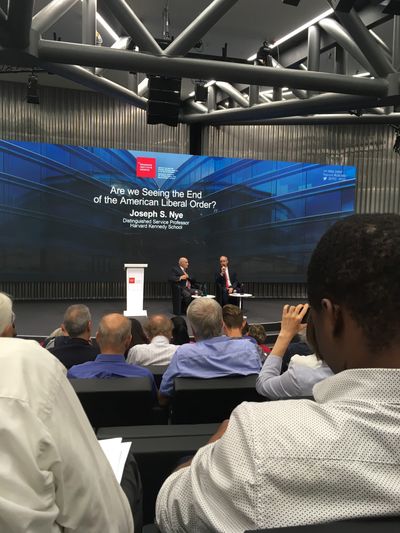 Joseph Nye at the Graduate Institute — Jun 16, 2017Joseph Nye was at the Graduate institute to address the question Are we Seeing the End of the American Liberal Order? He did not want to give a yes or no answer but rather to introduce ideas with which to frame and understand the context of the question looking back in history but also looking at contemporary issues. In so doing he spoke about why the aftermaths of the First World War led to war and why the Aftermath and attitudes after the Second World War led to 75 years of peace. He spoke about Hard Power and Soft Power. He spoke about how with Soft power we find attitudes that everyone wants to adopt and participate in. What I like about lectures by such individuals is that they really know their topic in depth and they understand it. They are well read and they have taken an active role in the topics they discuss. As a result when they come up to the podium their hands are empty. He did eventually pull out a single sheet of paper and occasionally looked at it. He talked with authority, and occasionally humour. Here are a number of videos Verhofstadt, Merkel, Macron and others believe in Soft Power, they believe that through mutually advantageous projects we can all benefit. Just yesterday roaming fees were terminated for European countries. This means that we can now travel and communicate in any other European country. Soft power is the opening of borders for trade, education and more. It is about trust and similar goals. It is about collaboration. As a result of yesterday’s talk I want to read his books. I want to learn more about the topics he discusses and delve deeper into the context. We must neutralise the populist discourse by understanding what led to so many years of peace. It is important not to regress....
 -
Jamaican Gang Culture And South African Drug Culture - Unreported World — Oct 17, 2007As I write this I am happy that I have been to watch quite a few interesting documentaries at the Frontline Club. The two most recent were made for Channel 4’s Unreported World. This is channel four’s “acclaimed foreign affairs series” and covers a number of topics. The two documentaries I watched were South Africa: Children of the Lost Generation and Jamaica: Guns votes and money....
-
It's Vacation Time — Jun 5, 2007it’s vacation time are words that were uttered at the end of a long night in crete back in 2000. They were uttered by an older guy who was with a group of us as we watched the sun rise. Those words always stuck in my mind....
-
It's Tuesday Morning — Jul 17, 2007Have you ever used a computer so much that it becomes part of your way of life and your person? There are two computers with which I have done this. The first of these was an IBM ThinkPad during the IB and the second was an iBook during my two final years as a BA Media studies student in London. If you look at the keyboard for both these computers you will see telltale signs. One keyboard the joystick mouse was completely worn down from use although the machine was fine. In the second case, the computer has nice wear patterns. The right side of the space bar is worn smooth as is the trackpad that serves as a mouse. All the keys are smoother as well. A slight discoloration of the keyboard took place where my left wrist used to rest. I like it when machines are worn because it gives them character and they have seen you through so many different emotions over time. It’s the reason why, when you use another machine you lose inspiration. This does not apply only to computers though. It also applies to cities. When you’re living between two towns, i.e. London and Geneva you’re going to avoid re-creating an entire universe of friends in the place where you are only passing through. There are a number of reasons for this of which one is the effort to meet those who were friends. Whilst London is about metropolitan activities, bars, restaurants, museums, and such Geneva loses some of the allure it had held whilst I was living in Switzerland. I have felt a great shift whereby I am now in love with the countryside and walk along the paths. I put on my shoes, turn on the iPod and start walking. I walk far. I start striding, rather than walking. I have a large gait as a result of which I make fewer steps but propel myself faster. I leave one village and come to another. I turn my head to the left and I see some trees. Behind these trees, fields and a lake. On the other side of this lake, I see the Mt blanc in all of its glory. I walk further and get to the next village. Here I see two communal halls, four tennis grounds, a football ground, and more fields. In these fields, I find Combine Harvesters and trailers for the crops. I walk and I notice whether the fields are flooded, whether the crops have grown by much. I also smell nature. Has it just rained, is it about to? Are any people coming the other way? At this point, there are a number of choices. I can continue straight on until I hit on the road which means the walk is twice as far, I can turn right and walk along the trees passing by a beehive, or I can walk towards a clump of trees where a fountain stands. On one walk it’s at this walk that a woman was letting her dog rest as it had overheated. I walk upwards, to the foot of the mountains, and then head for home. This is a walk I’ve done for years. I used to do it during the IB years and I still do it now although the path has reversed. I love the walk because it’s the moment when all the ideas are cleared. It’s a moment of solitude, of peace. It’s what I need. In London, there is also a walk I enjoy but there are many more people therefore the peace of mind is not as great. I am one of those people who love to walk fast. I walk whenever I have the chance, whether it is raining, snowing, windy, hot or cold and I get far. It’s so relaxing. You get to see the world and you really get to know the city or countryside where you find yourself. That’s how I got to know a beach resort town in the South West of England. It’s how I got to know the area where I live both in the Swiss countryside and Geneva itself. It’s also how I’m getting to know London. It’s important to know a city on foot because if something happens then you may easily make your way home or to work. You might also notice details that many others have never noticed. More than anything else though it simply gives you a good feeling. I don’t need a gym when I easily walk five to ten kilometers a day....
-
It's All Over - Mission Accomplished — Jun 2, 2007Checking through my pockets this morning I found that £30 are still there in cash. That’s quite surprising when you take into account that last night’s mission was to drink the bar dry. Obviously I did not contribute to this as greatly as was initially anticipated. It was another night of relative madness. It was a night that involved getting to the bar around four or five in the afternoon and chatting to many people and listening to many others. It was a night where people trickled in until it closed at 3 am. During this time sambuca shots were drunk, people partied and others argued. The fire was the final part of the night. At this point, I was in bed for the second time that morning sleeping my way into today. They got the police to come to the fire and one person was even taken by car around the building and released. This was simply to scare everyone into behaving themselves. It was probably amusing to see all the conspiratorial drunks spreading rumours and insults at this point. The wake-up call was quite original today, a fire alarm. The last halls fire alarm I will ever hear and I can honestly say it’s not going to be missed in any way shape or form. To all those whom I partied with over the past three years, it’s been both a pleasure and an honour. See you around....
-
It's A Nice Upgrade — Jun 14, 2007Today I passed an order through the online apple store and within a number of weeks I should get one of the top of the range machines and I’m really looking forward to it. The Ram isn’t maxed out but that’s because I’m going to upgrade that from an other distributor from whom I can get it cheaper. I’m also getting final cut studio 2 and that should be a great convenience for learning how to use all the software I need for professional purposes. I’m impatient for it now but it’s going to take time to come so I have to be patient… need to find something to distract me for a period. I’ve had an editing system at home which started with Adobe premiere 4.5 and the miro dc30+ and a hi8 camera, upgraded to a PC7 camera for a trip to Tanzania in 2000. That’s when I was editing on the DHR 1000 editing deck where I learned a great deal about tape to tape editing. From there I upgraded to Premiere 5.0, 5.1 and on before giving up on Windows editing. In 2003-4 I upgraded to the Ibook with FCP which worked far better than anticipated. Now I’m waiting for my most recent editing system. Over the years I’ve seen a great change in equipment and the price. As I was at school working on Hi8 it took several years before I was able to edit the footage I had shot. Editing systems could cost thirty thousand swiss francs per BetaSP decks. Now it’s gone down in price and people get a nice home setup. I’m looking forward to it....
-
Invisible without a website — Oct 8, 2007Having a website is essential in today’s media landscape for one simple reason. You don’t exist until I can hyperlink to a website containing examples of your work and describing what you do. This is particularly true in today’s new media landscape. For the minimalist among you a facebook or myspace page is the bare minimum. For those of you that take your work seriously though a website is more efficient. There are a number of reasons for which having a website is essential. The first of these is visibility. If you’re going to an event and you take hundreds of pictures then no one will notice them unless you share them publicly. You don’t need to be published to get your big break. That’s the point of viral marketing. Produce some content. Make it public and then mention it in a few places. If it’s good then others will advertise that work to friends from now on. You are now visible. That’s in an ideal situation. Yesterday when I went to the protest (which event? Describe it in a few words and link to it) I met two friends, one is a well established photographer whilst the other, is, as yet a relatively anonymous face in the crowd. With the established friend it was easy for me to link to his work because he has a high quality site. It’s something concrete, easy to see and assess. For the second person there is not much I can do to demonstrate their worth except mention their name but is of limited value, without a link. Why? Because there is no action to follow a “plug”. The plug is a term used to describe how one person promotes their work through another person’s content, whether it be in website form, podcast or other. As you are talked about more frequently, your visibility increases and, with it, people’s interest in what you do. John C Dvorak of Dvorak.org/blog is the best example. Anytime he can, he will mention his website and, although for the first ten times you may not react, you will go to the website, eventually. He’s got another reader. Whilst you’re surrounded by new media people everyone has a blog, a website, possibly a podcast and more. Leave this group, though, and most people are “invisible”, except, for young people, facebook. Most of them are shown in their bikini, at drunken parties or in other situations that would not reflect well within more traditional work environments. That’s why facebook should be kept private and personal, confined to a group of friends. When you apply for a job online, you’ are one of a thousand applicants. It must be a nightmare reading all those applications. I am taking as an example the work I did for blogwise, a human moderated database of websites. Each day several hundred people would apply for their blog to get through. As you look at the first ten your mind is clear and you’re interested. After several dozen you’re tired and by the time you reach several hundred you skim through. The same happens when you’re applying for work - boredom sets in. When you think about how much time people spend looking for content and entertainment on the web you begin to understand why and how important it is to have something to show. When I worked on my dissertation I looked online and found an interview of Jacques Yves Cousteau a matter of minutes after he won his Oscar for Le Monde Du silence. I needed, for a documentary, a soundbyte of Rupert Murdoch speaking about Myspace - and after several months of searching we found the key clip. That’s also how a documentary maker found my content for use in a documentary that will be on ARTE television in Spring 2008. The point is simple. In the past when you created content and you wanted people to notice you the best method for visibility was to be mentioned in physical examples, whether magazines, DVD or on the air. Today we’re all part of the same media landscape. What this means is that there is unlimited time for content to be shown. But how do you stand out, to get noticed? If there’s an event taking place and you have the time to cover it, then do it - and find where people are actively talking about it. That’s a great way to promote your work. If people see your latest video and want to find out more about you, they can go to your website, if you have one, to see further examples of your work. They read your blog to see your thoughts, they follow your twitter stream to see whether you’re a party animal, they check your linkedin profile to see who you know that they may know and, as a result, they get a better idea of what kind of person you are. You’ve just increased your chances of being noticed - and hired....
-
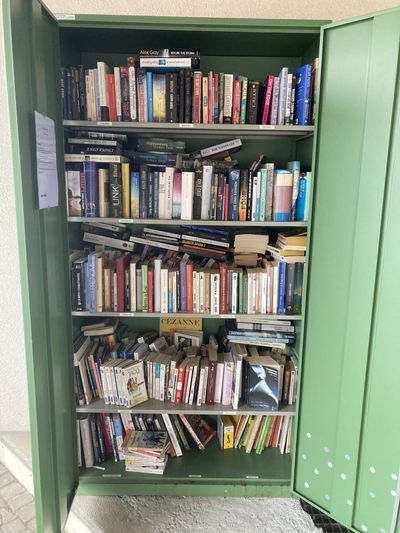 I Want to Dump WordPress for Laravel — Jan 31, 2023For at least a year I have been annoyed with WordPress, not because it went from the classic editor to Guthenburg but because it now uses React and I hate the idea of using React because it was a FaceBook project. I don’t trust Facebook and I don’t want to use anything related to them....
 -
I Graduated — Jul 14, 2007My university life is officially over now that I got the piece of paper saying that I graduated with an Upper Second class degree. It came in the mail yesterday morning but I read it in the evening....
-
Great Britain and the Fourth Estate — Jun 27, 2016When I think of Great Britain I think of the BBC and I think of the Natural History Units. I also think of radio programs like In Our Time, From Our Own Correspondent and Hard Talk. I also think of BBC World and the quality of their news coverage. I mention these current affairs programs because I believe that the British provide quality content. They also inform, educate and entertain us. That is their purpose. In a healthy media environment the media should inform and educate their audiences. They should provide us with the facts and context for everything they write about. They should provide us with neutral and unbiased information. Radio and Television broadcasters were held to this standard until recently. With Video on demand services increasing in number and with the number of channels made available through satellite broadcasting and digital audio broadcasting opinion has found its way on air. This made it easier for satellite and television broadcasting to share opinions rather than facts....
-
Forums Are The Sandbox Of The Web — Aug 15, 2007The concept of community is an old one, coming from an evolutionary need for more than one pair of eyes to watch out for predators and other threats. over time the sense of community has evolved and become as great as it is today. There are however pockets of social discord. I believe that forums are the sandboxes of the World Wide Web. In chatrooms, there are always three or four people who chat together in the public space, whilst all around people ask A(ge), S(ex), L(ocation) - or at least they did. Today, everyone has a profile and the question is now redundant. When individuals stir up trouble the room will resolve this problem. Just two nights ago whilst on operator11.com, I saw a little skirmish that was quickly resolved and I realised that even when people are in an audiovisual medium online there can be moments of tension. \\nof Apple products or part of the scientific community. They are built as a\\nplace where conversations and debates can take place. They can help you resolve\\ncomputer problems or advertise the work you've done. They are great because\\nwhilst they require participants to spend a lot of time over a period of weeks,\\nthey are relatively\\u003cbr\\>\\neasy to interact with. If you want to write a long post you can, and if you\\njust want to say that you agree or disagree, you can say so in just one line.\\u003cbr\\>\\n\\u003cbr\\>\\nSome of these groups have become tight knit, like villages or year grades\\u003cbr\\>\\nwithin a school. Everyone knows everyone else and so a "gang\\nmentality", for\\u003cbr\\>\\nlack of a better term, arises. They all send each other private messages,\\nthey've met and they've chatted. They've been friends for years. They're\\nisolated hence my use of the word sandbox. As you spend more and more time in a\\ncommunity so it feels like your home and feels like a place where strangers are\\nno longer welcome. I've been a member of many forums and I've been known to\\npost heavily within these\\u003cbr\\>\\ncommunities, but only when I am accepted. For a long time I was a member of two\\ncommunities and I would spend hours in both. \\u003cspan style\\u003d\\"background:yellow none repeat scroll 0%\\"\\>\\nI wrote about them so if you do a little research you can\\neasily find out which ones they were.\\u003c/span\\>\\u003c/span\\>\\u003cspan\\>\\u003cfont size\\u003d\\"1\\"\\>\\u003cspan style\\u003d\\"font-size:8pt\\" lang\\u003d\\"EN-US\\"\\>\\u003ca href\\u003d\\"#11465b58cd9c2969\_\_msocom\_3\\" language\\u003d\\"JavaScript\\" name\\u003d\\"11465b58cd9c2969\_\_msoanchor\_3\\"\\>\\n\[PA3\]\\u003c/a\\>\\u003cspan\\>\\u003cspan\\> \\u003c/span\\>\\u003c/span\\>\\u003c/span\\>\\u003c/font\\>\\u003c/span\\>\\u003cspan lang\\u003d\\"EN-GB\\"\\>\\u003cbr\\>\\n\\u003cbr\\>\\nToday for the first time in months I joined a forum and decided to\\u003cbr\\>\\nintroduce myself, after seeing that someone on Facebook had\\u003cbr\\>\\nrecommended the site. I wrote my post and looked at other websites for\\u003cbr\\>\\nsome time before returning to the site. I read one comment and it was\\u003cbr\\>\\npositive but the second one was offensive. It's common knowledge on\\u003cbr\\>\\nthe world wide web that 80% of communication is non verbal therefore",1\] ); //--> That’s on a medium that’s fleeting. You write your comment, then someone else does and you have a conversation which will disappear whilst the ideas remain. Forums are another social beast. They take a lot of time to create and require a number of elements. First, they need people who spend a lot of time online. They can belong to communities of artists, fans of Apple products, or part of the scientific community. They are built as a place where conversations and debates can take place. They can help you resolve computer problems or advertise the work you’ve done. They are great because whilst they require participants to spend a lot of time over a period of weeks, they are relatively easy to interact with. If you want to write a long post you can, and if you just want to say that you agree or disagree, you can say so in just one line. Some of these groups have become tight-knit, like villages or year grades within a school. Everyone knows everyone else and so a “gang mentality”, for lack of a better term, arises. They all send each other private messages, they’ve met and they’ve chatted. They’ve been friends for years. They’re isolated hence my use of the word sandbox. As you spend more and more time in a community so it feels like your home and feels like a place where strangers are no longer welcome. I’ve been a member of many forums and I’ve been known to post heavily within these communities, but only when I am accepted. For a long time, I was a member of two communities and I would spend hours in both. I wrote about them so if you do a little research you may find which ones I am talking about. Today for the first time in months I joined a forum (which I will not identify) and decided to introduce myself, after seeing that someone on Facebook had recommended the site. I wrote my post and looked at other websites for some time before returning to the site. I read one comment and it was positive but the second one was offensive. It’s common knowledge on the world wide web that 80% of communication is nonverbal therefore if you write something be aware that it may be misunderstood. If it’s written and it’s within a forum then beware of the gang mentality because they will attack you. I wrote a response to the message I received and asked what that person thought should be the second line of the introduction, rather than the one I had written. That’s when one member and then another, and then a third began attacking me, dissecting and ripping apart any simple mistake, as if they were piranha on a lamb’s leg. They had a field day, really enjoying the destruction of my persona. I was hurt. I thought that this was going to be a professional website where I could have an intelligent conversation and advice on how to get work but instead they showed a complete disregard for social civility on a web forum. You don’t use caps lock and you don’t use bold characters to make your point. You write in one font and make sure that you’ve understood what was intended by the post. They didn’t. I’m reminded of the reason why I am no longer part of any forums (although I still have my logins.) Why be part of something small when you can part of something bigger, on a global scale. The blogosphere and web 2.0 are based on the idea that you’re part of a global interactive community. Anyone can become part of it and you prove himself by the quality of his writing and logic. There are groups of friends, but these are healthy. They look outwards and have no boundaries. It is for this reason that a new generation of social groups has formed on the World Wide Web. These are based around communities in the physical world. \\nmake sure I know how to be a better member of the community but they\\u003cbr\\>\\nwon't attempt to destroy me. If there is a problem they will help me\\u003cbr\\>\\nand show compassion. They will show each other this.\\u003cbr\\>\\n\\u003cbr\\>\\nWhen I went to the Twitter meet up I met some great people. I met people who\\nshare my in technology - the conversation was easy. They all write and expressthemselves\\nin public forums. They have blogs, audio podcasts and video programs and\\nthey're interacting in an open system, where you know their names. It's\\nwelcoming. It's the mature web. It's web 2.0. It's filled with ideas and\\ndynamism. Goodbye grumpy, rude flamers - stay in your rat hole of a forum.\\u003c/span\\>\\u003c/p\\>\\n\\n\\u003cdiv\\>\\n\\n\\u003chr align\\u003d\\"left\\" size\\u003d\\"1\\" width\\u003d\\"33%\\"\\>\\n\\n\\n\\n\\u003cdiv\\>\\n\\n\\u003cdiv language\\u003d\\"JavaScript\\"\\>\\u003cspan\\>\\u003ca name\\u003d\\"11465b58cd9c2969\_\_msocom\_1\\"\\>\\u003c/a\\>\\u003c/span\\>\\n\\n\\u003cp\\>\\u003cspan\\>\\u003cfont face\\u003d\\"Times New Roman\\" size\\u003d\\"1\\"\\>\\u003cspan style\\u003d\\"font-size:8pt\\" lang\\u003d\\"EN-US\\"\\>\\u003cspan\\> \\u003ca href\\u003d\\"#11465b58cd9c2969\_\_msoanchor\_1\\"\\>\[PA1\]\\u003c/a\\>\\u003c/span\\>\\u003c/span\\>\\n\\u003c/font\\>\\u003c/span\\>\\u003cspan lang\\u003d\\"EN-US\\"\\>What's ASL? Explain\\u003c/span\\>\\u003c/p\\>\\n\\n\\u003c/div\\>\\n\\n\\u003c/div\\>\\n\\n\\u003cdiv\\>\\n\\n\\u003cdiv language\\u003d\\"JavaScript\\"\\>\\u003cspan\\>\\u003ca name\\u003d\\"11465b58cd9c2969\_\_msocom\_2\\"\\>\\u003c/a\\>\\u003c/span\\>\\n\\n\\u003cp\\>\\u003cspan\\>\\u003cfont face\\u003d\\"Times New Roman\\" size\\u003d\\"1\\"\\>\\u003cspan style\\u003d\\"font-size:8pt\\" lang\\u003d\\"EN-US\\"\\>\\u003cspan\\> \\u003ca href\\u003d\\"#11465b58cd9c2969\_\_msoanchor\_2\\"\\>\[PA2\]\\u003c/a\\>\\u003c/span\\>\\u003c/span\\>\\n\\u003c/font\\>\\u003c/span\\>\\u003cspan lang\\u003d\\"EN-US\\"\\>What do you mean? Convoluted\\u003c/span\\>\\u003c/p\\>\\n\\n\\u003c/div\\>\\n\\n\\u003c/div\\>\\n\\n\\u003cdiv\\>\\n\\n\\u003cdiv language\\u003d\\"JavaScript\\"\\>\\u003cspan\\>\\u003ca name\\u003d\\"11465b58cd9c2969\_\_msocom\_3\\"\\>\\u003c/a\\>\\u003c/span\\>\\n\\n\\u003cp\\>\\u003cspan\\>\\u003cfont face\\u003d\\"Times New Roman\\" size\\u003d\\"1\\"\\>\\u003cspan style\\u003d\\"font-size:8pt\\" lang\\u003d\\"EN-US\\"\\>\\u003cspan\\> \\u003ca href\\u003d\\"#11465b58cd9c2969\_\_msoanchor\_3\\"\\>\[PA3\]\\u003c/a\\>\\u003c/span\\>\\u003c/span\\>\\n\\u003c/font\\>\\u003c/span\\>\\u003cspan lang\\u003d\\"EN-US\\"\\>Explain\\u003c/span\\>\\u003c/p\\>\\n\\n\\u003c/div\\>\\n\\n\\u003c/div\\>\\n\\n\\u003c/div\\>\\n\\n",0\] ); //--> That’s where Facebook, MySpace, and Twitter come in. These three social networking websites work on one simple principle. These are friends that you know in real life, people you have shared dinners with, worked with, played with, and grown up with. Everyone knows each other and behaves himself. If I say something out of line five others will make sure I know how to be a better member of the community but they won’t attempt to destroy me. If there is a problem they will help me and show compassion. They will show each other this. When I went to the Twitter meet up I met some great people. I met people who share my interest in technology - the conversation was easy. They all write and express themselves in public. They have blogs, audio podcasts, and video programs and they’re interacting in an open system, where you know their names. It’s welcoming. It’s the mature web. It’s web 2.0. It’s filled with ideas and dynamism. A little later in the day I checked the website URL and found out that this was a free forum that was part of a larger domain. Good forums are all paid for by the community leader. As a result, the conversations and sense of community are far more welcoming and that’s what people look for before joining....
-
Finding a new flat — May 19, 2007There are a lot of people currently in need of a new identity due to their university lives coming to an end and I am one of them. Today I went flat hunting and there are a few things I found out about myself. The first of these is that I really don’t want to live in a box room. I went into a room today and it was so small I would soon hate living there. Another truth is that I have lived with one wall to a kitchen in the place where I am living for the past three years. What this means is that when the last person is chatting in the corridor is chatting in the corridor I will hear it. When the first person wakes up and goes to the kitchen and moves things I will hear it. The net effect is napping, as would wildlife in order to survive. I don’t want the landlord living in the same house. There is something wrong with a landlord living in the house, mainly they have authority and ownership. If you throw a party they will come but charge you later for the damage. If they leave all the lights on you will foot the power bill. If they get sky you will also pay the bill. If you enjoy going out then you will not take as much advantage of these things. I want to be further from the living room. The living room is the worst place to live next too. Of course I love being sociable. Had I not been banned from the local bar I would have gone there every day for three years, almost, due to my friends being there. Recently I’ve been out two or three times in two weeks. Some level of passion died in me when my ban occurred. I want to be where it all happens. I want to be closer to the centre of town where I can walk to where things are going on. I want to be free to go out without having the consideration of “can I handle a 45 minute ride on a London nightbus”. There are a number of things I would like from a flat. One of these is having space. I want to have enough space to store my possessions and keep the floor as tidy as possible. I want a clean kitchen and I want some space in the fridge if possible. I want to make friends with those I move in and see that they are living interesting and diverse lives. I do not want unimaginative idiots who think only of getting drunk (to be distinguished from going out every night to be sociable. They’re two different things). I want to be close to a few shops so that I may go shopping and actually want the food that is on offer. I want to look forward to dropping by and finding a diversity of meals I can prepare. I want to be able to lock my door, I want good plumbing, none of that bath dripping down into the kitchen as I’ve experienced. I don’t want a tile floor on wooden floor boards. Wood moves and tiles don’t bend that way. Overall I want to find a flat that would feel like home. I want somewhere where I have a few friends, where I can be social if I want to but when I want isolation and if I need sleep for an early morning job I can. I’m looking forward to finding a new house and the life it will bring with it....
-
Finding a new flat — May 19, 2007tomk - Jul 1, 2007...
-
Facebook, a personal rather than social network — Aug 28, 2007Ten years ago if you met someone and they gave you their visit card you’d put it away somewhere and eventually you might have come back to it but the information would need updating. Over the years social networking tools on the web have evolved from simple mail clients to web forums and finally to Myspace and Facebook. With Facebook we find what I think of as an enhanced phonebook. When you meet someone at a party today there’s a good chance that this individual has a facebook presence. As a result when you go home they may add you as a friend and in so doing you are brought into their lives. You can see where they’ve worked, for how long and what they were doing. you can see whom they associate with and how they tend to meet people. Facebook has become a daily feature of contemporary life. Facebook does not limit your interactions to the people you’ve met during your time at parties, events and more. It also allows you to join groups, some are based on occupation, others on passions and yet some more on soemthing that may be relevant to only ten to twenty people. As these groups multiply so you decide to associate through these people through forums and the likes. For a time I was part of the Lecture napping appreciation society whilst others were part of the “curse of the N18” amongst other groups. Today a friend joined a group which I would never join for the simple and good reason (simple et bonne raison) that reflects the views for which I avoid the place. I’m living between London, a city of up to twelve million (depending on the demographics you chose) and a village of no more than 2000. I love the contrast between the two and as a result feel no need to visit the place that the group boasts about. The point is that as a medium becomes more commonplace and as more people feel comfortable with the technology so their personalities are reflected in a variety of ways which give a great wealth and diversity of character to the medium they are using. It is precisely because of those differences in interests that we gain as a social group. We, the international internet users, have a great wealth of opinions and views available within a few keystrokes and we should constantly aim to promote those interests that most effectively reflect our character, things that friends may take years to notice but that can be made obvious online. Facebook, in my opinion, is a personal, rather than social network where you promote the interaction between friends you’ve had for years and friends you’ve only just met. There are other networks that are great for making new online friends but Facebook should be kept for those people whom you have met face to face....
-
Estimated Delivery Date 03 Jul 2007 — Jul 3, 2007If that’s true then my MBP is waiting for me in Switzerland but I’m stuck in London for another week before i can go back and get it. Tonight I’ll find out whether a note was left by the delivery company and soon I’ll start up the computer for the first time. I’m looking forward to that. Once it’s home it’s home and the suspense is no longer there....
-
Dissertation Results — Jun 28, 2007Today is a great day for a number of reasons. The first of these is that I woke up early, which means I slept enough. The second of these is that I dropped into university and was sad to see all those empty bedrooms, which shows there are some good memories from halls. The key to today was getting my dissertation grade. That’s the reason I dropped by the uni. Tired of the anxiety and worry of grade results I heard from a friend that the results were there. I went and checked my grade and in the process saw quite a few others. One friend I traveled with got a 70 so I’m really happy for him, this being the top grade out of those I looked at. I found that I was in agreement with the feedback I got, mainly that I should have concentrated more on the socio-economic side. Part of the reason I didn’t was that it was hard to find data on this topic. If I did the exercise again I would work harder on doing better. Another good piece of news is the following. My MacBook Pro and the software I ordered have been shipped and they should arrive around the 11th of June. I’m really happy and looking forward to this. It means I have a new toy professional tool to play study with. I dropped by the apple store and took advantage of the wifi at the apple store for a few instants and did the geek thing, watching a mediocre presentation of Imovie. I think I’ll try to get to one or two more advanced shows, see what secrets I can pick up in the process....
-
Dirty Gold War screening at the Graduate Institute. — May 3, 2017I went to watch Dirty Gold War at the Graduate Institute at lunch time today. The film is interesting because it makes you think about the environmental impact of gold mining. We’re familiar with the stories of gold mines in South Africa. We’re familiar with the stories of the gold rush. We don’t often think of the environmental impact of Gold mining in rain forests in Latin America. This documentary introduces the topic well. It brings our attention to the fact that when people buy luxury products like gold watches, bracelets and other objects they are buying objects that have no environmental or ethical credentials. It leads us to question when the luxury industries will be accountable to such considerations. Mobile Phones, laptops, televisions and other devices all contain traces of gold. If that gold is sourced from environmentally unfriendly sources then we are contributing to the destruction of the rainforests and the poisoning of ecosystems. Fairphone and other companies with such goals benefit from such documentaries because we are shown why their goals are so important. It contextualises their mission and their reason for being. It also helps to put pressure on all electronics manufacturers to do more to reduce their impact on the environment. Dirty Gold is a topic that does not get much attention. As I reach the conclusion of this blog post I find that Dirty gold points to a music album rather than gold mining. We need to raise awareness of this topic. People are wearing wedding wings, luxury products and using electronic devices that are in part for the degradation of the environment. As awareness of these issues grows so companies like Apple, Sony and others should work to ensure a clean product line, from raw material in the ground to the finished product....
-
Dependability — Oct 2, 2007"...
-
Cheapening the user experience — Aug 24, 2007There are a great diversity of websites out there and each one has it’s own strengths. As a result of this it is not unusual for me to visit twenty to thirty websites on a daily basis, from the likes of twitter, my own website, news sites and more. What this means is that I find the tools that are best for what I want to do on a variety of websites. To each website it’s own purpose. That’s why I’m so dissapointed with what facebook has become at the moment. In the good old days of e-mail use you would start with a clean account and every e-mail you received you wanted. As a result you might get one or two e-mails every few days but they were of interest. Over time spammers started sending their junk and this personal space was less personal space. At around the same time friends began sending chainmail, participating on “which character are you most like” and other activities. As a result of this there was a lot of static which meant more time would be wasted processing the influx of information. This problem then came to social networking websites. One of the weaknesses of myspace was that everyone could put megabytes of junk on their pages and the website would slow down and crash certain browsers. In other situations people spam you via the bulletin boards in such way that you start to ignore them. I thought that facebook was different. I used to view facebook as a mature online community that was about people keeping in touch with their friends. The sharing of personal images, personal videos and personal work was great. That is, until the api came along. A I look at the daily requests on facebook I have zombies biting me, I have several application requests that do the same thing for music and more. The “questions for friends” api is one of those useless api that makes you sign into a service you don’t want to use so that you can read the question a friend wants to ask you. The “compare me to my friends” api is another annoying one. Yesterday I noticed that I was more likely than someone else to do something and I signed up for the api, unselecting all the elements that would advertise the api to those in my news feed. I wanted to see whom I had been compared to but found out that I had to answer fifty questions before being able to use the api. At this point I removed the api. The beauty of the World Wide Web is the vast amount of specialised websites and tools that allow for the sharing of a variety of elements. If I want friends to know about my travels then I’ve got World66, website I used before going to Poland. If I want to talk about good food and restaurants then I’ll drop by Trusted Places and read what users have written. If I want to play games online then I’d go to Kraland, nainwak, travian and a number of other websites. I see Facebook as the modern version of the phonebook where I can keep up to date with what friends are doing and where they are geographically. I enjoy the ability to see photographs and videos of what they’re doing but hate being spammed with movie trailers and other junk. I want facebook to be about my network of friends and what they’re doing in the real world. If there is too much extraneous content then I shall be looking for a less populist website. The fact that it’s been banned in certain work environments demonstrates it’s declining value as a social networking website....
-
Blog Wars at the Frontline Club in London — Jan 16, 2008Blog Wars is a documentary taking a look at how bloggers influenced the political debate in the state of Connecticut. It’s 58 minutes long and covers some interesting points but that’s not what I’m going to write about. For me what was interesting was seeing who was present. For a start I didn’t expect for the venue to be full. I expected to see only a few people but that wasn’t the case. Most of them didn’t look like bloggers. Their phones weren’t out to tweet and their laptops weren’t in site. From the questions I think this assessment is correct. I’m going to use my twitter notes in order to bring out some of the points I thought could be of interest. My first comment was about people sounding passive rather than active about blogging. In other words they are looking at the process of blogging as readers rather than producers of content. This is interesting since the cost is low for blogging. One of those involved in the production of this documentary did tell me at the end of the session that he loved reading blogs but that it was far too time consuming for him to write anything. A second point that was made is that of deep linking. Someone in the crowd brought up the comment that whilst in Mainstream media all the information must be prepared in advanced and accurate with blogs we get a person’s opinion and due to the ability to link to those documents or sources it is up to the blog reader to look at issues in more depth should he desire this. Some attention was placed on the forged document about Bush’s record but not much of note was mentioned. A question about the difference between British and US blogging was brought up and it was brought up that US blogging is far more fun and exciting than that of England because of the debates. There was also a comment about how the tabloid press in England can already dissent against those in influential positions. As an aside to this attention was brought to how blogs are helping to chart Brown’s deciline from public favour. Some time was taken to see just how influential blogging can be and there was a feeling that had the Swift Boat story in the US been taken more seriously and had the issue of forged documentaries been followed up the impact would have been far greater. One of the problems with bloggers was that one woman doctored an image which meant a loss of credibility for one of the candidates. I was amused by one person’s comment about how blogging is live and instant when I’ve already seen the efforts made by twitter users during the New Hampshire and other primary votes in which Barak Obama got a clear lead. Anyone remember Obama girl… some blogs showed why he progressed in the polls. (Look these details up. This is simply a summary and commentary). The point is that Twitter may play an important role over the next few months so people should keep an eye on this new method of disseminating information. Overall the conversation was interesting and it felt good to have experience of the topic discussed. I’ll look forward to more of these events....
-
Black Gold - Documentary about ethiopia and coffee — Oct 28, 2007Whilst in Paris I was given a coffee due to a misunderstanding between the waitress, a friend and I and as a result this was the first coffee I ever finished. It’s almost a week later and I’ve just been to see the documentary Black Gold which discusses the plight of Ethiopian coffee farmers. The documentary is shot in an observational style with the use of intertitles rather than voice over. As a result those that are telling the story are those that are most affected. We have one main character who works on bypassing several links in the chain from farmer to coffee shop whilst having the conventional chain being illustrated in parallel. The documentary touches on a number of interesting points but I will leave that to you to discover as you watch the documentary. The documentary producer was present at this screening and took some time to explain the reason for which he chose this topic, how certain coffee companies tried to discredit the film as a result of which I think some time should be taken to get more information about the topic out there. Fair trade is a hot topic so why not have a blogactionday which is focused on poverty alleviation and which informs us about what should be changed and what is already been done....
-
Bill Palmer of Iprong 3c, twittermail3k twittter 3k+ — Oct 15, 2007Today’s news is as follows. Having seen that Bill Palmer of the Iprong podcast and website would add the 300th friend on Facebook I decided I would take this opportunity to add him. His podcast is "for the ipod generation so take the time to listen to it. It’s mainly about iphones and ipods but mixes in quite a few artists in the process. The second event was becoming the 3000th person to use twittermail. I saw someone mention that they were up to three thousand and I decided to be the 3000th. Now that’s done it’s great. It’s twice as great since it helps to emphasise that I have reached over three thousand tweets since becoming a twitter member. The last bit of news is that it’s blog action day tomorrow. The topic is going to be the environment so right anything with an environmental conscience for your blog and share it with the world. That’s it for tonight....
-
Audible books and Kindle Unlimited — Mar 18, 2015This year I have set myself the goal of reading 30 books. I am currently on track to reaching that goal. Most of my reading material comes from two sources. Audible.com and amazon.de. What I like about reading books via Audible.com is the freedom it gives me to do something at the same time as people are telling me stories. This habit was born from listening to podcasts while I went for hour long walks. Over time podcasts went down in quality and my time was taken up by other activities. As a result of the scarcity of time I moved towards audible books. Audible books provide me with an opportunity to listen to stories and learn whilst I do other things. I can listen to them while I commute, while I go for hikes or while I mow the lawn. As a result of this ability to multitask I have finished many more books than I would finish if I was only reading. I am an audible platinum member and I pay in advance. This gives me the option to buy 23 books a year. Audio books are not cheap when you buy them individually so buying a subscription makes sense. Below a certain price I buy the books and use credit when the value justifies it. For at least two years I have felt justified in keeping the subscription. I am lucky because I like to read on electronic devices. I have used iphones, android phones, iPads, iPad Mini, Tablets and a kindle for reading. As a result of this I always have several books with me at all times. I have a tendency to buy many more books than I have the time to read. This is especially true of books when they cost less than an airport coke. Eventually I will get to read them. Today I took a step which may make conventional book readers envious. I will test Kindle Unlimited for the next month. I can “borrow” up to ten books simultaneously per month. I can be as uncommitted as ever with books. I am working through the James Bond Collection and reading three history volumes at the same time. I “read” the history volumes as audio books and this allows me to enjoy the nice weather we have had. When I am in a fixed location I can read James Bon books on the kindle. At the end of the trial month we will see whether I keep using Kindle unlimited....
-
As featured on Operator 11 — Aug 22, 2007After a long but great day of work I came home to do The Twitter Vox show with Loudmouthman and two guests. We were joined by Goldie Katsu and Malburns. We discussed what it’s like to reach 3000 tweets and the conversation moved towards the advantages of using twitter when part of global communities like Second Life. We had some interesting insights and the conversation progressed well. It’s a good show and can be found here....
-
Appreciating The Gotheburg — May 19, 2007Today I went down to see the East India ship sailing under Tower Bridge. First time in three years of living in London I see the draw bridges raised. Bands were playing and spectators were watching....
-
Andrew Keen, Cynthia Mckinney and Jeff Blankfort — Sep 11, 2007I recently dropped by the Frontline club to listen to what Andrew Keen had to say and his talk was really interesting. There are a few ideas that I found were interesting and I’m still planning on getting something written up about the event. Last night I met up with Documentally to record an interview before going to Cynthia Mckinney’s talk about confronting the empire. She talked for twenty minutes or so before giving the floor for a Q&A session at which man questions were asked. She got a standing ovation at the end of her presentation. I will find a few interesting elements and post them to this website and others shortly. Jeff Blankfort was also present at the event highlighting certain moments in his career....
-
And That's When Flames Caressed My Leg — May 25, 2007Last night after visiting my new flat and getting to know one of the people that live there I came back to the bar in Halls to chat with friends but that didn’t last long as there was a lack of atmosphere. Everyone migrated to the field and that’s when it’d become more interesting. Whilst some people went to get firewood we broke some branches into more manageable pieces, got some newspaper, and started a fire. I love building up fires so I helped to encourage the flames and attempted to make the fire catch. After a few minutes it did and some people came with palettes and other flammable things onto the fire. We got a nice big flame going and the fire was so warm we had to be at least ten meters away. Some were drinking beers, others were drinking wine. I eventually went to get a coke because it’s too warm otherwise. Occasionally the grass would light due to the heat and start migrating away from the fire and I kept having to put those fragments of fire out. Occasionally the fire was so hot that there was nothing anyone sane would try to put out. At one point I saw the grass light in a few areas so ran towards there and stamped on it. My body created a little area of low pressure which meant the flame caressed my trousers. It didn’t combust but one or two people did yell a warning. I walked away. It’s at about this time that I stopped maintaining the fire. It was burning very nicely. Eventually, the security guard came and asked who started the fire. “we don’t know” was the answer we gave, of course, after all, it was a team effort and we’ve finished the academic year anyway. He prowled around but there wasn’t much he could do alone. He would eventually call both the fire department and the police to come and take care of the fire. This was one of the amusing moments. The field is shaped in such a way that there are steep banks down which the fire truck could not come. As a result, we could see the fire fighters trying to work out a way to get to the fire and extinguish it. Eventually, they drove as close as they could before pulling out the fire hose and spraying the fire. Many people cheered this as fourty onlookers had gathered. A little later the police came and told us to go back into our rooms. Some people stayed on but I went home and eventually went to sleep. Nice way to mark the end of term and uni life....
-
An Interesting Podcast — May 22, 2007I listen to a lot of current affairs programs but occasionaly I enjoy listening to more light hearted podcasts. Over the past two or three days I have been listening to John Foster’s Beerschool. This is a podcast aimed at those who want to learn to appreciate more than one type of beer. He also jokes that “the best part about beerschool is of course the homework” which consists in drinking beer. It covers the San Francisco area speaking about a variety of beers and the breweries and bars where they are served. It’s a great resource for those who may drop by that part of the world and want to experience that aspect of the culture. Aside from this point I was recently mentioned in their podcast for a comment I wrote about the “Rockstar” program. I was quite amused by this....
-
 An emotional BREXIT — Jul 9, 2016The More I think about BREXIT and the more I think that those of us, like me, who see themselves as British Europeans the more the BREXIT referendum is painful. BREXIT is painful for us because we are born in one country but we are nationals of at least two or three nations. We cannot call ourselves British because we went to uni but not school so we have not picked up that culture. We visited family on holidays but we are not locals. I believe that a high percentage of my generation went to uni in England probably worked at least temporarily before leaving again. As Europe based brits we remember when we were thinking about which universities we would go to and we thought about whether we would have home fees / Europe fees or international fees. At the time the difference was from 1000 GBP to more than 7000 GBP, excluding all other costs. That does shape whether you go to university as well as when. As an EU citizen living in Switzerland I always have the frustration of counting as an EU rather than British citizen and if I am really unlucky because of the current mood of politicians then I end up on international fees. In theory that is no longer an issue. Another aspect that I rarely see discussed in BREXIT discussions is that of emigrating from the UK to find jobs. In the post I shared a few days ago I had seen that several industries that were in Northern England migrated to France, Germany and other EU countries. In theory those who say they lost their jobs could migrate to continue doing the job that they enjoy. the European Union provides people with the opportunity to study, work and more with great freedom. The only challenge is to learn the local language. In Switzerland we see that Brits and other English speakers spend twenty years in the country without becoming fluent. At this moment in time we can travel from any country in Europe to any other country in Europe without a second thought. I really appreciate this freedom. My friendships and activities revolve around spending time with emigrants. I could use the word expat but it does not feel like an accurate portrayal of our identity. I was brought up in the international community where everyone is a migrant so see ourselves as citizens of the world. In this sense at least the International Baccalaureate has achieved its goal. BREXIT is a direct attack on the identity that friends, colleagues, family and fellow citizens of the world have. We can see endless opportunities as long as we are willing to travel, as long as we are willing to re-skill and as long as we are willing to adapt to new situations. The remain campaign and Pro-European movements are looking forwards rather than backwards. We are enthusiastic about the future rather than nostalgic about the past. BREXIT aims to destroy something that has been built over decades rather than weeks or months. The European Union is organised. Verhofstadt and others still believe passionately in the European Union and the benefit that it can bring to Europeans and those they deal with. We need to listen to such people. They have a vision for the future, they have an action plan. We should collaborate with them to turn it into a reality that we can all benefit from. The European Union is about a continental rather than national identity. It is about a set of universal values of equality, education, open mindedness and more. We need to keep that ambition alive and make it thrive. In a healthy media environment it makes sense for the whole of society to want what is best for everyone....
 -
A Healthy Amount Of Downloading — May 29, 2007[...
-
860 k/bits per second on wifi — Jul 21, 2007I am currently downloading at about 800 k/bits per second which is some of the fastest downloading I’ve done, especially from home over a wifi connection. It’s a broadband connection but using one of the latest wifi cards. That’s the current speed...
-
17 After the Event- Carrying the Conversation Forward — Sep 22, 2007There are two key events I have been to since the beginning of summer. These are PodcampUK and the Twitter Meetup. Both of these events have been followed up by a continuing collaboration between participants. The first event was the London twitter meetup. I went there knowing just two participants, Sizemore and Jess. Over the night I would end up with interviews with quite a few members of the London twitter community but nothing much would be done with this footage as a result of not having known that I would be doing these interviews. It meant collaborating with Jess and getting an edit ready in the hope that GETV would use it. They didn’t so that was slightly dissapointing. I met another individual. Nik Butler of Loudmouthman.com. Following on from a good conversation on the twitter meetup night we decided that we would collaborate on other projects. One of these is ongoing, Twittervox. Twittervox is a weekly roundup of the week’s twitter news in review. It’s had over 2600 views over that time with up to four live participants at once around the world ranging from the US to different parts of Europe. That project has been featured by Operator 11 on a number of occasions which I would like to believe is testament to it’s good content. Twittervox is also of note because it introduced me to Phil Campbell and his work. Since this was a few weeks before Podcamp UK it meant that I would know at least two members of the conference. At Podcamp UK I got to meet quite a few of those who are part of the British podcasting landscape, from teachers to academics, broadcast professionals and hobbyists. This broad range of people would lead on to more projects. There were some interesting conversations and presentations which brought me some new ways of seeing certain aspects of the podcasting stream of content creation. It would make me think of podcasting as the equivalent of Amateur sports in relation to it’s “threat to broadcasting.” Within a week I was sitting at the Frontline Club listening to Andrew Keen but that was written abo I’m glad I met Documentally whilst at Podcamp because of possible future collaborations we may work on in the near future. As of yet nothing is set in stone but already I’ve met him a few times to work on three or four projects which you can find on his website and on a number of video sharing websites already. From what I’ve described above what I’ve found is that the conversations from events are leading onto some interesting projects and that it’s been a good transition from the student life into the professional one. It’s been a great opportunity to meet some interesting people and through blogs, twitter and meetings in the real world the conversation is as healthy as ever. I feel I’ve gained from these events and their aftermath and look forward to participating to many more in the weeks and months to come....


